
Highlights
- Uzbekistan is one of the few growing sources of uranium that Western utilities can turn to for supply: State miner Navoiyuran doubled output in three years to 7,000 tonnes in 2025. The government wants 15,000 tonnes by 2030, and Navoiyuran has touted an IPO to fund its expansion ambitions.
- Acid Intensity: Its mines dissolve uranium out of the ground with sulphuric acid, and Uzbek ore historically requires twice as much as Kazakhstan’s. 15,000 tonnes of uranium would need about 3 million tonnes of acid a year, nearly double what the whole country produced in 2024.
- 2026 - Acid: This year, the extra acid came from fertiliser makers. When the Almalyk copper smelter, the country’s largest acid source, fell 11% short in the first half, Navoiyuran still got 102% of its allocation; the largest fertiliser maker got 64%.
- From 2027 - Sulphur: New acid plants burn sulphur from Uzbekistan’s sour gas fields, and gas output fell 16% in January-August this year. Most of the sulphur Navoiyuran buys at home comes from Russia’s Lukoil, which operates under a US sanctions licence.
- Imports: Sulphur abroad is hard to find. Russia has banned exports and the Hormuz closure has spiked world prices, leaving Kazakhstan and Turkmenistan. Kazakhstan, whose government owns the majority of Navoiyuran’s biggest competitor, supplies most of Uzbekistan’s imports. Turkmenistan has sulphur to sell but has supplied Uzbekistan only a few thousand tonnes this year. At the latest Kazakh delivered price, sulphur alone would add about USD 14 per pound of uranium, more than half of Navoiyuran’s 2025 cash cost.
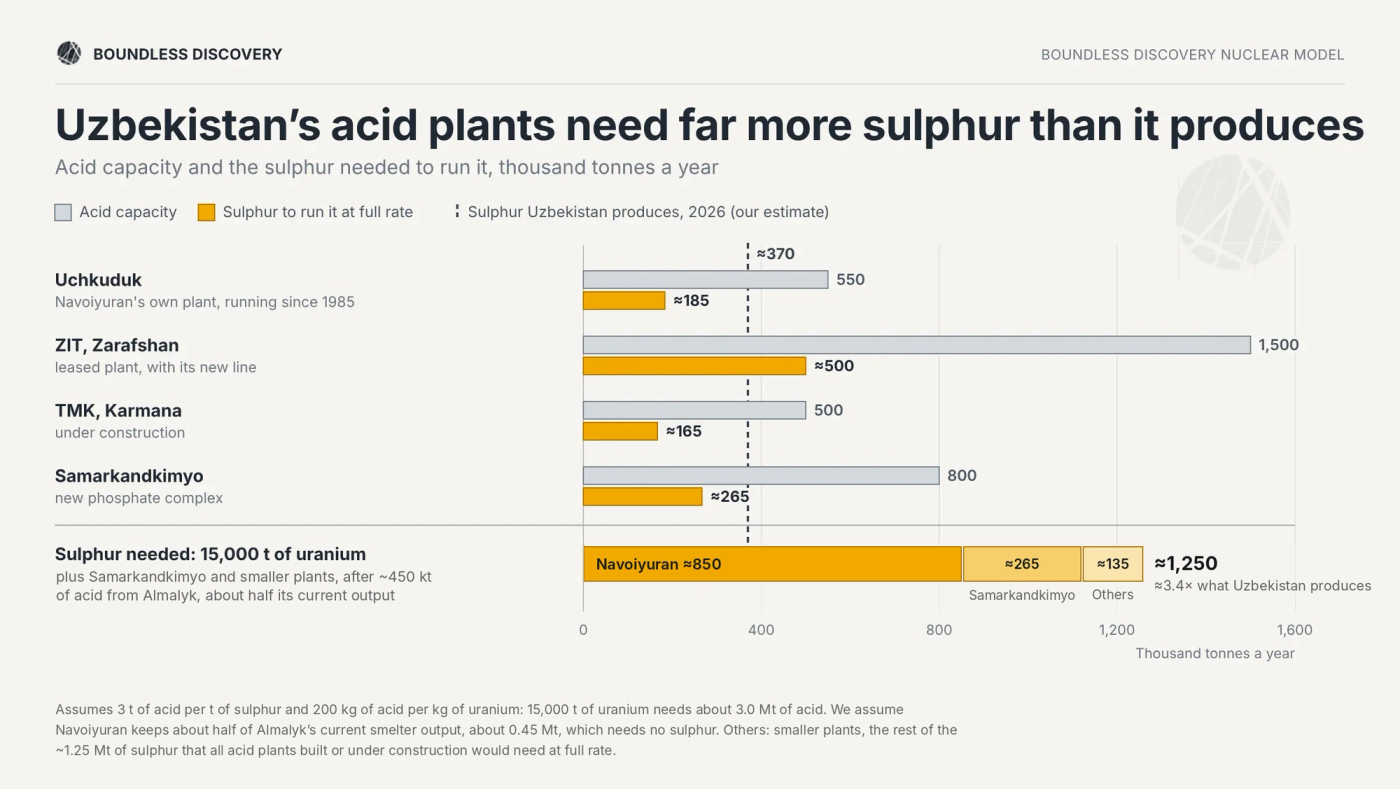
- The Acid Test: Reaching 15,000 tonnes would take about 850,000 tonnes of sulphur a year for Navoiyuran alone, more than twice Uzbekistan’s output. A new Uzbek copper smelter makes acid without sulphur, but its tender timetable points to years of delays ahead.
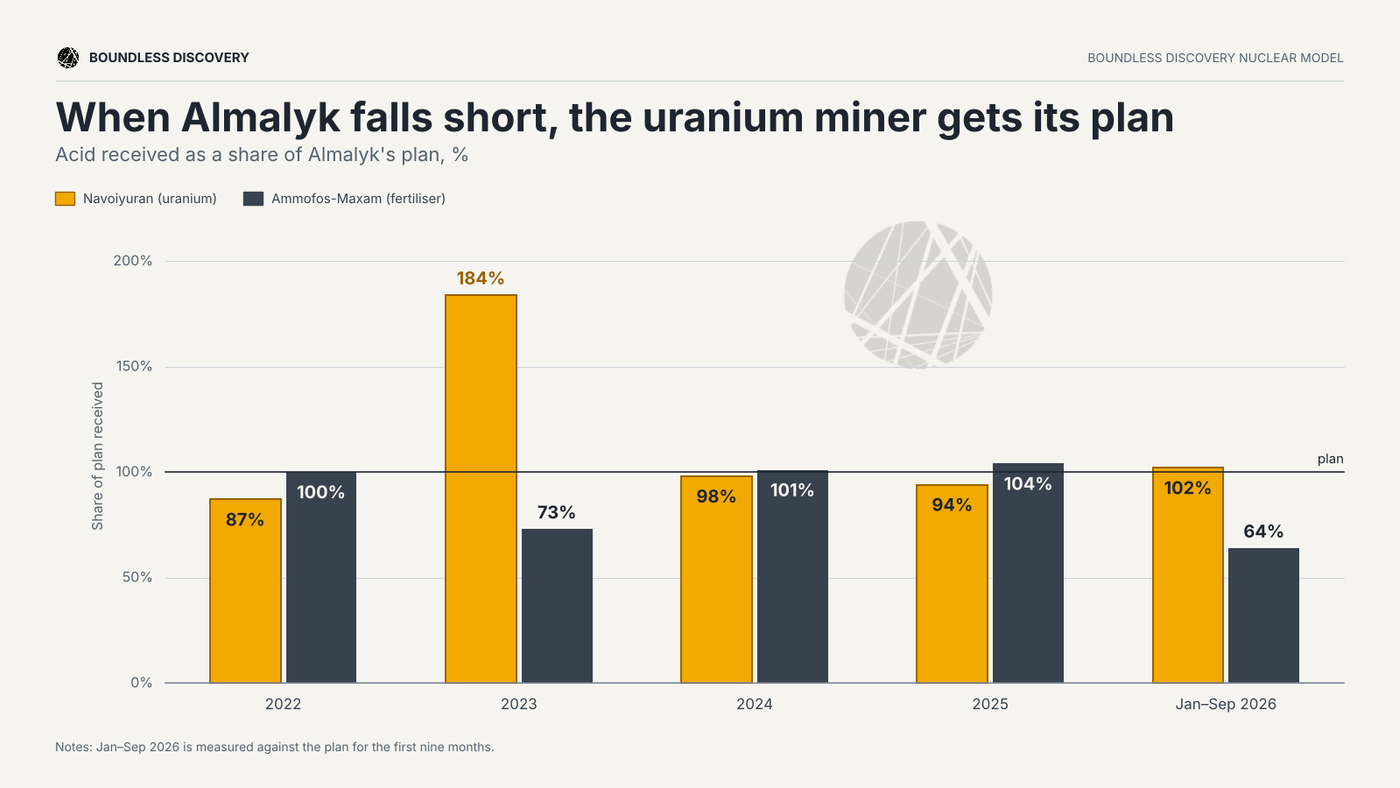
In the first half of 2026, the Almalyk copper smelter, Uzbekistan’s largest source of sulphuric acid, fell 11% short of its production plan. Navoiyuran, the state uranium miner, still received 102% of its planned allocation. Ammofos-Maxam, the country’s largest phosphate fertiliser maker, received 64% of what it was due.
This appears to be how Navoiyuran is meeting its targets: by taking acid that used to go to fertiliser. Its output doubled in three years to 7,000 tonnes in 2025, and the government wants 15,000 tonnes by 2030. Navoiyuran has shown it can buy wells, rigs and processing capacity. Whether it reaches 15,000 tonnes depends on acid, and on the sulphur used to make it, whose supply cannot be expanded so easily through additional spending.
Navoiyuran disclosed little until it began preparing for international bond markets and a possible IPO. Its 2025 Eurobond memorandum, state open-data filings, the national commodity exchange, procurement registers, lease contracts and satellite imagery let us follow the acid from plant to wellfield. Drilling and processing have so far grown as fast as Navoiyuran could pay for them. Acid has not, and the nature of the constraint changes over time, so we take it in the order it binds:
- 2026: Acid. This year’s target is being met by taking acid from fertiliser makers. After this year there is little left to take.
- From 2027: Sulphur. New acid plants arrive, but they burn sulphur that Uzbekistan produces less of each year. The rest must be imported, mainly from its biggest uranium competitor.
- The pace and cost of growth, even if sulphur eases. Each new field needs wells, processing capacity and acid before it produces, and the faster Navoiyuran grows, the more acid each kilogram needs. An IPO could pay for the wells and plants; acid and sulphur may be harder to buy.
Uranium Growth in Central Asia Runs on Acid
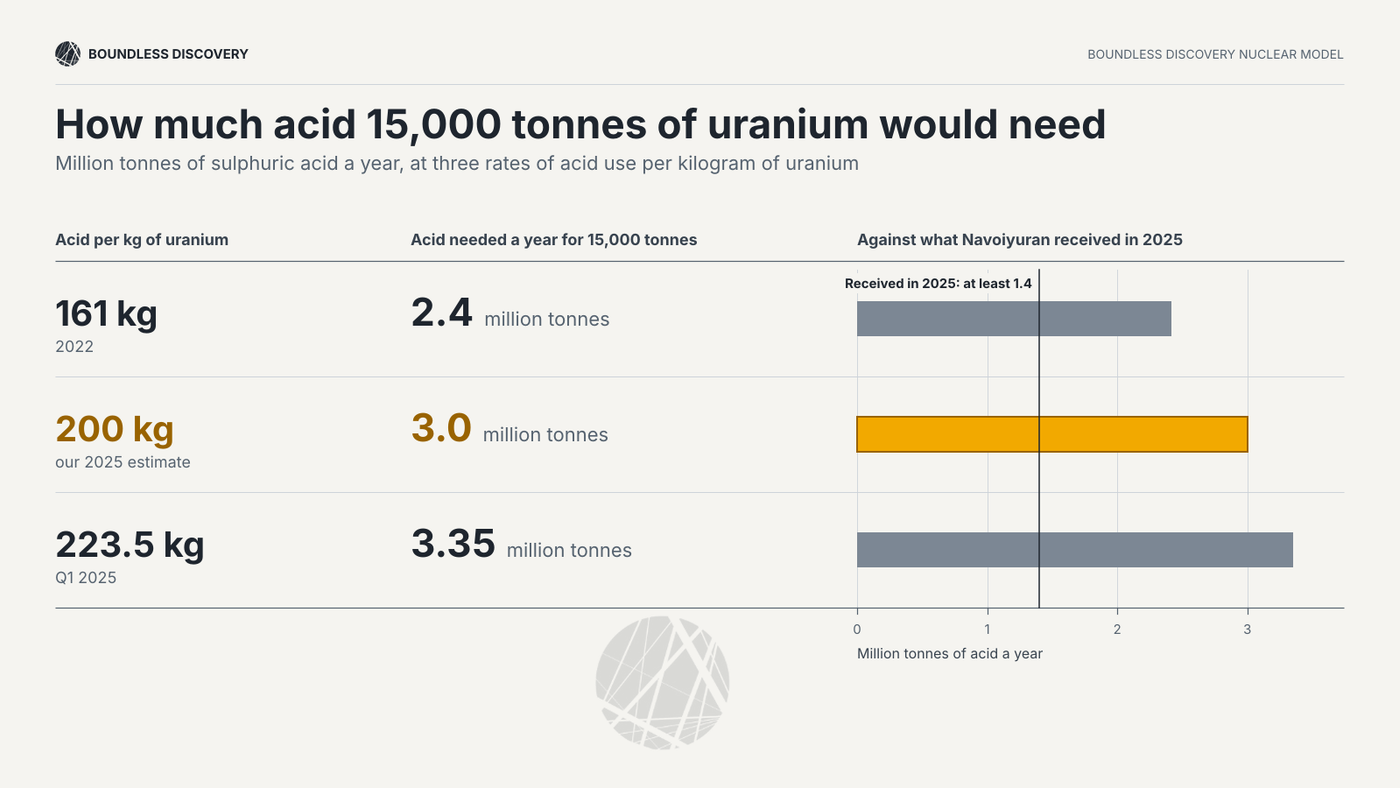
At recent Uzbek rates, 15,000 tonnes of uranium would need about 3 million tonnes of sulphuric acid a year, nearly double the 1.6 million tonnes the whole country produced in 2024.
Uzbekistan and Kazakhstan mine uranium the same way. They pump sulphuric acid through wells into underground sandstone and pump the uranium-bearing liquid back up. The acid is consumed, so every extra tonne of uranium needs fresh acid. Kazakhstan has already faced this issue: Kazatomprom issued its 2026 guidance subject to acid availability (Figure 1), and relies on imports, mostly from Russia, until its delayed acid plant starts, now expected between Q3 2027 and early 2028.
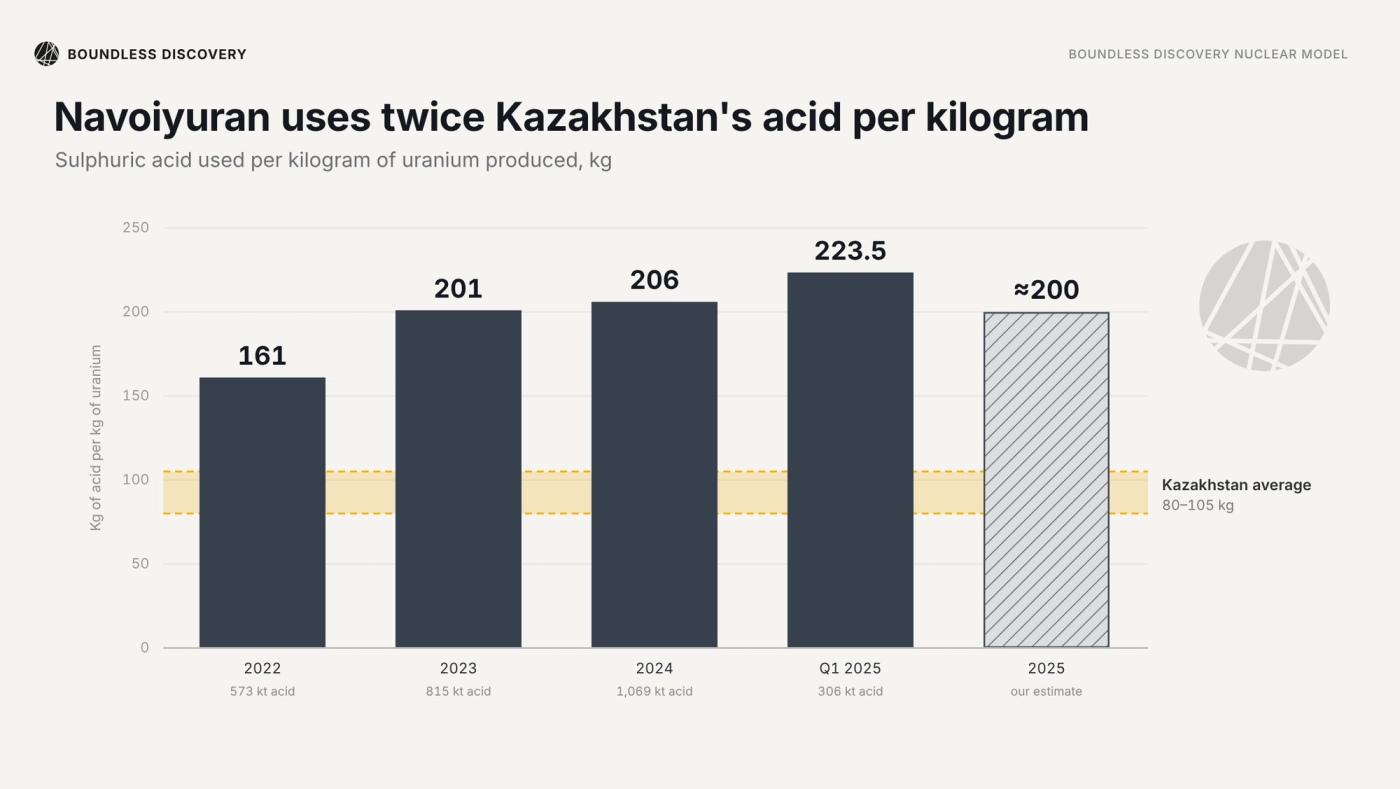
Navoiyuran’s bond disclosures tell us how much acid each kilogram of uranium has needed. Figure 2 plots the increase since 2022: 161 kg in 2022, 201 in 2023, 206 in 2024 and 223.5 in the first quarter of 2025. Kazakhstan uses roughly 80-105 kg.
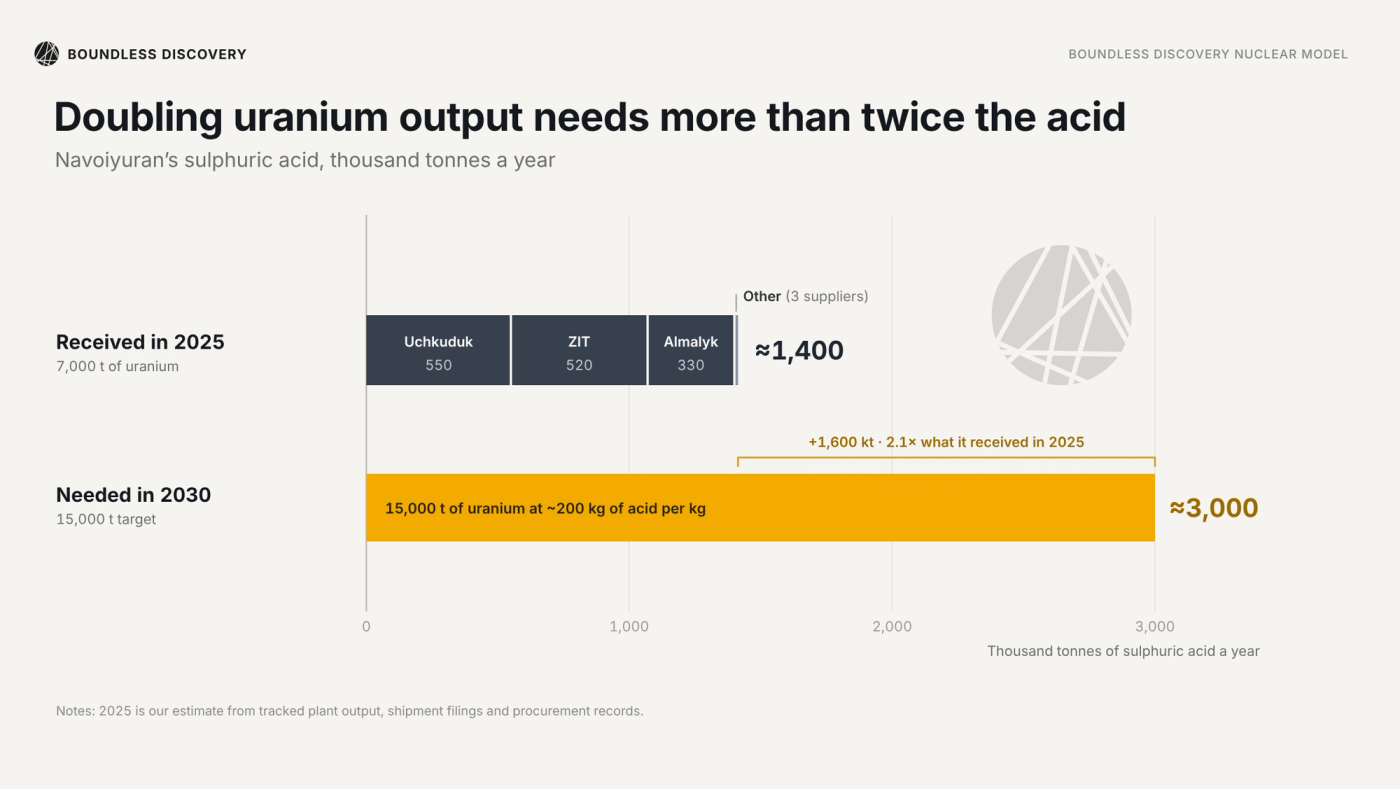
From delivery filings and Navoiyuran’s procurement register, we estimate it received at least 1.4 million tonnes of acid in 2025, which converts to 200 kg of acid for each kilo of the 7,000 tonnes produced. Despite Q1 2025 being significantly higher, we use 200 kg throughout for the basis of our forecast. At that rate, 15,000 tonnes would take more acid than Kazakhstan used to produce 25,800 tonnes in 2025. Part of the intensity is a choice: with less acid, Navoiyuran could still open fields, but more slowly. Figure 3 below breaks down where acid came from last year and what would be needed to hit 15,000 tonnes in 2030.
Acid is not the only input that has to double. Navoiyuran must also drill more wells, build processing capacity and find new deposits. So far, everything it could pay for has grown (Figure 5):
- Drilling. Production wells drilled rose from 1.4 million metres in 2022 to 5.4 million in 2025. Drill rigs at work rose from 78 to 210.
- Spending. Capital spending rose from USD 85m in 2022 to USD 551m in 2025.
- Deposits. 24 were in production and nine more were permitted in 2025. Qizilkok began commercial production in April 2026.
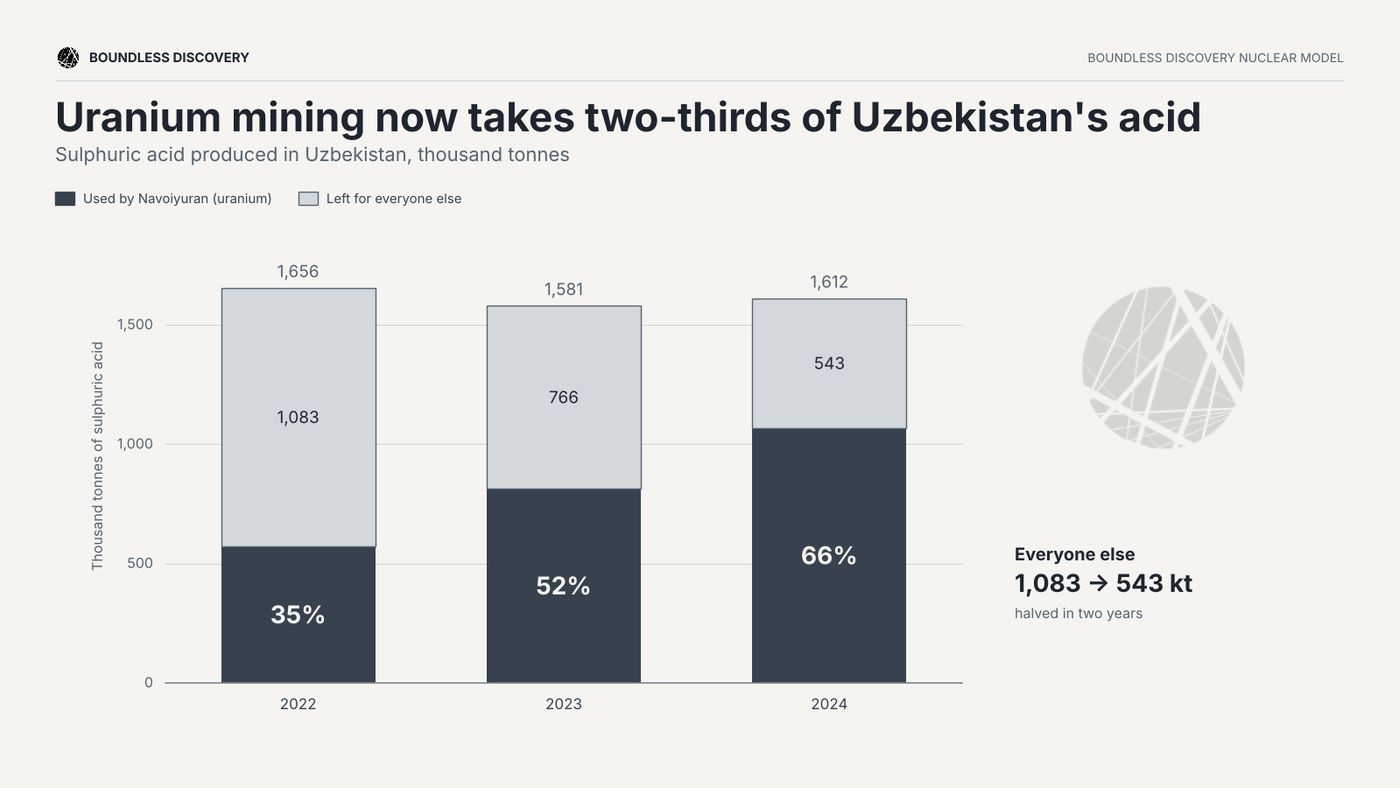
- Acid. Navoiyuran’s use nearly doubled, from 573,000 tonnes in 2022 to 1,069,000 tonnes in 2024, while national acid output stayed flat.
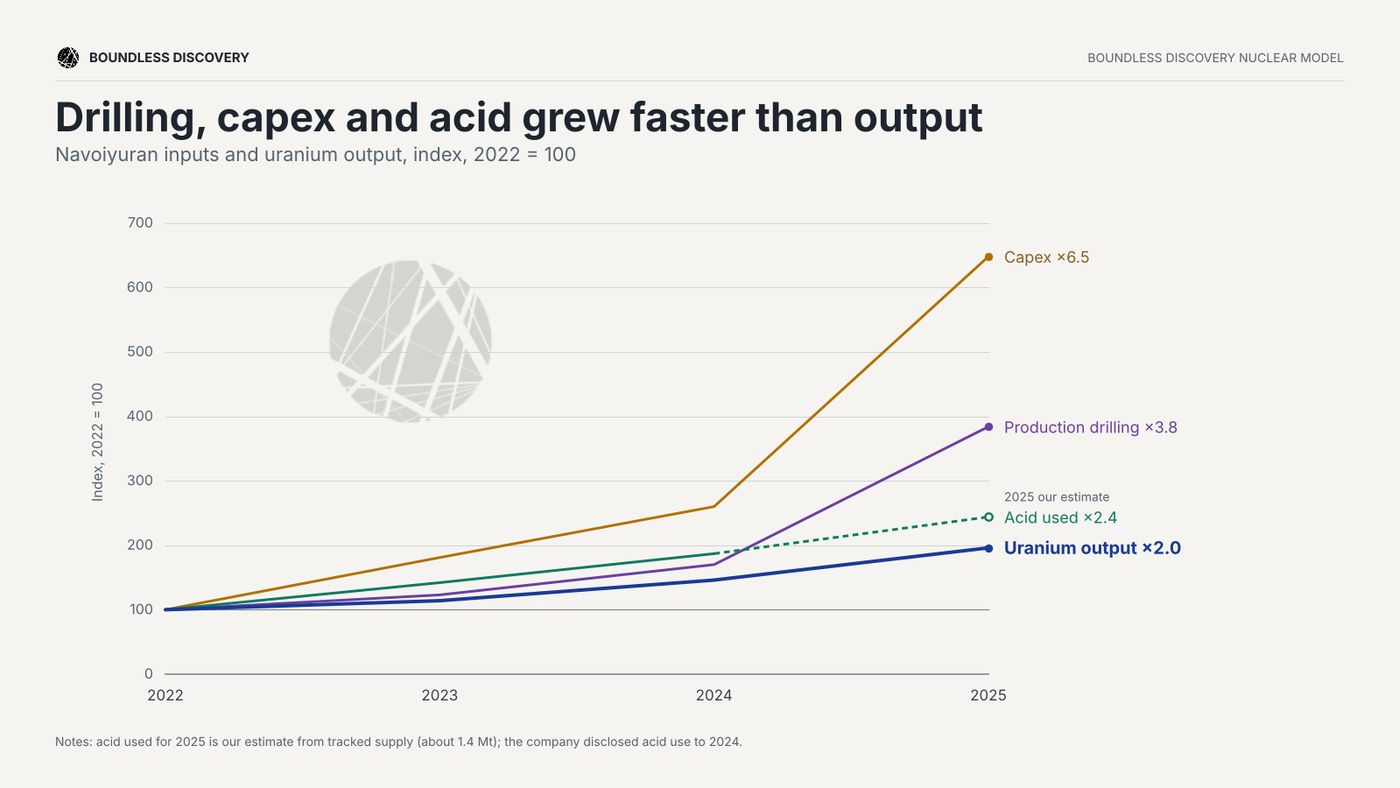
We rank acid and sulphur first because money cannot easily buy them, while the other inputs have so far grown comfortably with Navoiyuran’s capex—supported by a 4.3x oversubscribed US$300m bond last year. In 2025, it drilled 62% more than planned and processed 11% more solution than planned. Its output of 7,000 tonnes beat the 4,200 tonnes the 2022 national plan had set for that year by two-thirds. Acid, by contrast, had to be taken from fertiliser makers.
2026: Taking Fertiliser’s Lunch
The first constraint is the acid itself. This year, Navoiyuran’s extra acid came out of someone else’s allocation.
Uzbekistan makes sulphuric acid in two ways. Most plants burn sulphur, a by-product of cleaning sour natural gas. The state-owned Almalyk copper smelter instead captures the gas its furnaces release when they smelt copper ore, so it needs no sulphur, but its output is tied to copper production. Acid is heavy, corrosive and expensive to move relative to its value. Two industries use most of it in Uzbekistan: uranium mining and phosphate fertiliser.
Uzbekistan made about 1.6 million tonnes of acid in both 2022 and 2024. Over those two years Navoiyuran’s share rose from 35% to 66%, and the acid left for everyone else, mostly fertiliser makers, halved to about 550,000 tonnes (Figure 6).
The allocation plan for the Almalyk smelter, run by state-owned AMMC, shows how the acid is shared out (Figure 7). Disclosures show its planned and actual shipments by buyer for 2022–2026. Navoiyuran’s share rose from 16% in 2022 to 65% this year, and when supply falls short it is served first: in the first half of 2026 it received 102% of its allocation while Ammofos-Maxam, the country’s largest phosphate fertiliser producer, received 64%.
This year’s target of 8,000 tonnes can probably be met the same way: Navoiyuran reported first-half production 2% ahead of plan. At 200 kg per kilogram, 8,000 tonnes needs about 1.6 million tonnes of acid, and we estimate Navoiyuran can source about 1.55 million before cutting further into other buyers’ allocations at Almalyk.
After this year, little is left to take. Even if Navoiyuran took every tonne that went to other users in 2024, about 550,000 tonnes, it would support at most 2,750 tonnes of uranium, against the 7,000 tonnes the 2030 target needs beyond this year’s 8,000.
Taking even that much would likely be untenable. Uzbekistan currently has no nuclear reactors, so all of its uranium is exported; the first, a Rosatom unit at Jizzakh, is not due until the end of the decade. Fertiliser mostly stays at home: about 88% of output is used on Uzbek farms. In December 2025, the President ordered officials to ensure fertiliser makers received sulphuric acid on time, and set a target of 50% more fertiliser output by 2030. Six months later, the largest of them received 64% of its Almalyk allocation.
In the near term, a country which needs to choose between domestic food production or a highly profitable export is caught in a sophisticated gambit.
Looking ahead to 2030, most of the extra acid has to come from new plants, and they burn something Uzbekistan is running out of: sulphur.
From 2027: The Acid Plants Arrive—What About the Sulphur?
Uzbekistan’s domestic acid capacity is set to more than double, from about 2.35 million tonnes a year to over 5 million. Most of the new plants burn sulphur, and Uzbekistan produces less of it every year. The one large plant that does not, Almalyk’s new smelter, is years away.
How much sulphur the new plants need
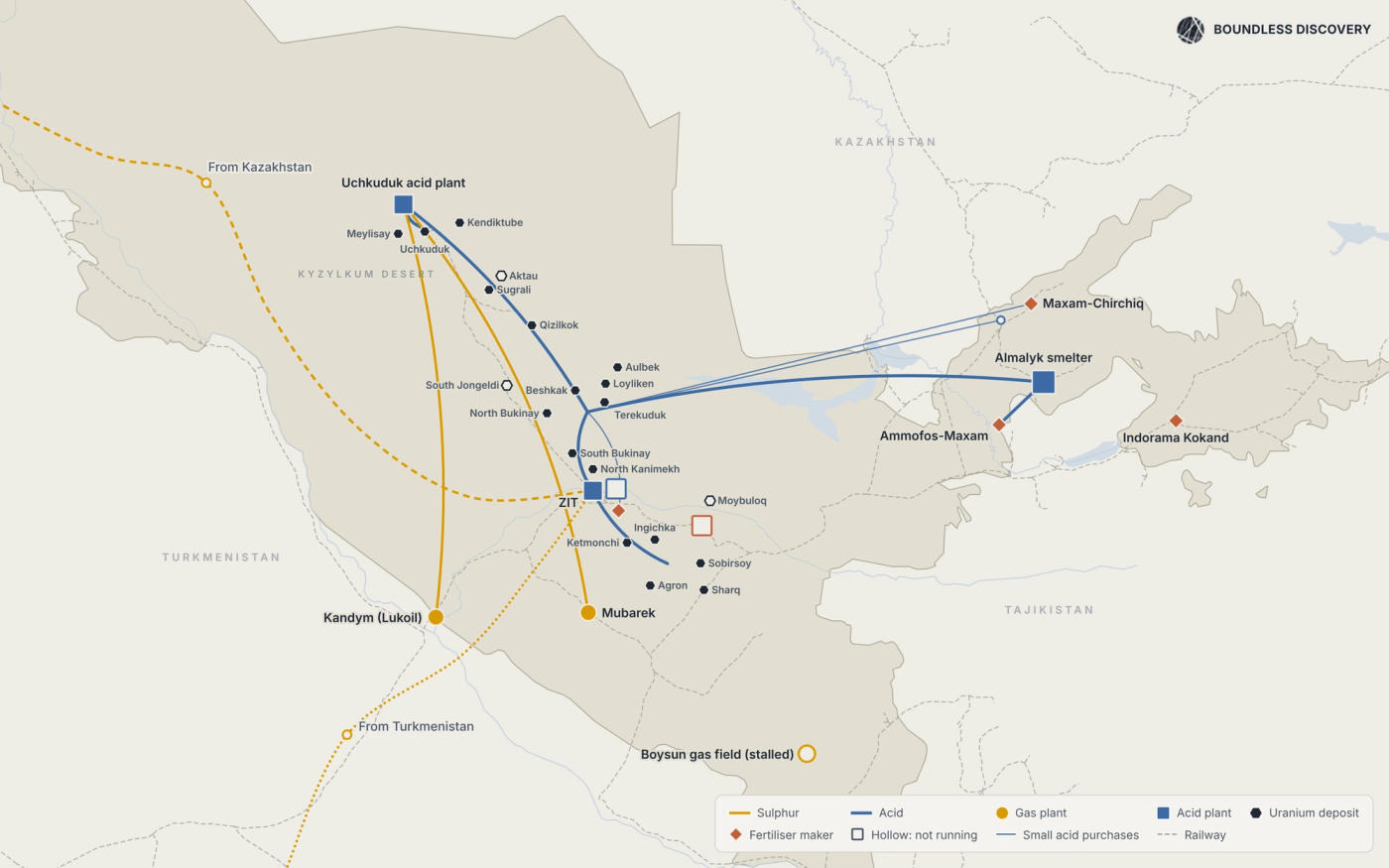
Navoiyuran draws its acid from three main sources today (Figure 9): Almalyk’s smelter, its own sulphur-burning plant at Uchkuduk, and a leased plant run by the private Zarafshon Industrial Technology (ZIT). A 500,000-tonne plant under construction at Karmana is behind schedule but set for commissioning at the end of 2026.
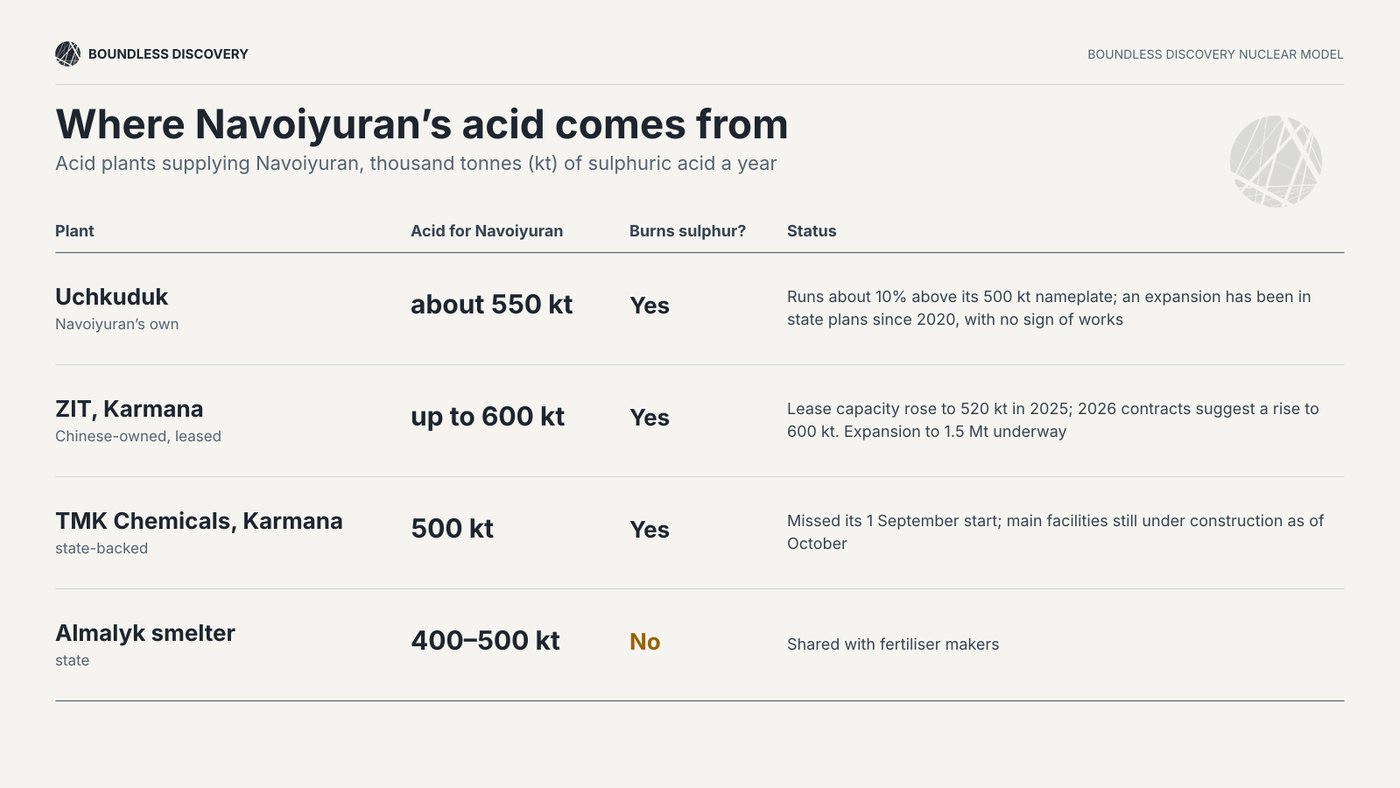
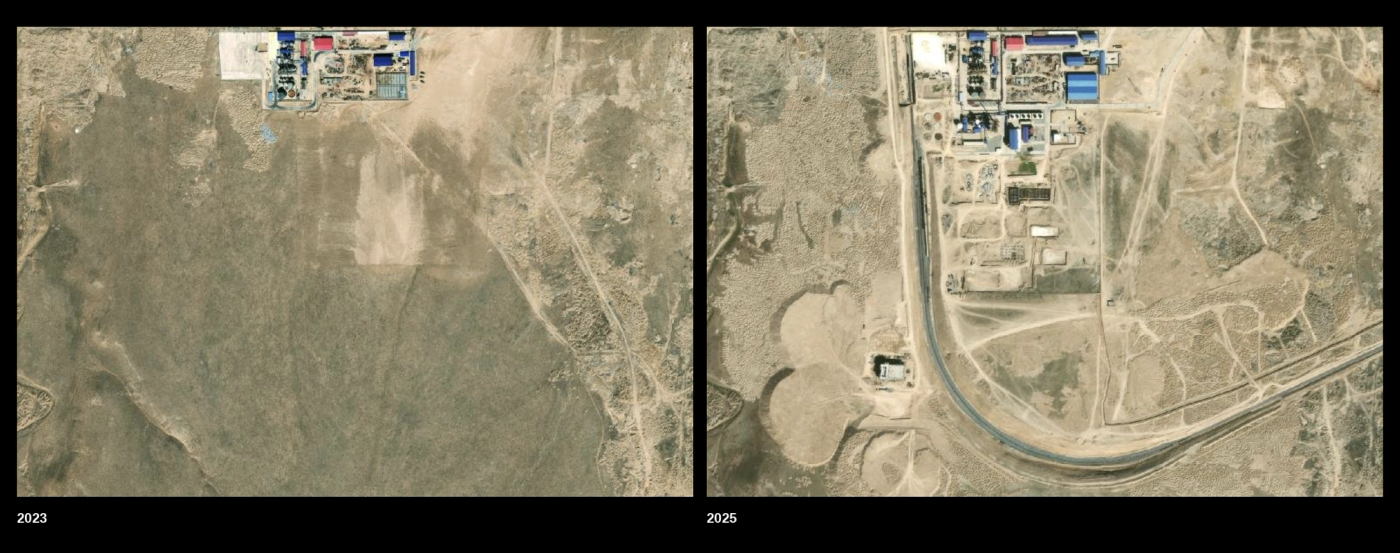
ZIT shows how the system works. Contract disclosures show that Navoiyuran supplies the sulphur and pays UZS 490,000 (about USD 39) for each tonne of acid ZIT produces. Presidential communications and Chinese tender records show ZIT building a new line of up to 1 million tonnes. With it, the site could produce 1.5 million tonnes of acid a year and burn about 500,000 tonnes of sulphur, more than Uzbekistan produces. Figure 10 shows the plant’s expansion over the past two years.
By our calculations, all the major plants built or under construction would together need about 1.25 million tonnes of sulphur a year, about three times national output (Figure 11). This also excludes some of the smaller fertiliser makers’ own plants. Reaching 15,000 tonnes of uranium before Almalyk’s new smelter runs would take about 850,000 tonnes of sulphur a year for Navoiyuran alone.. Fertiliser makers will also be competing for the same sulphur: Samarkandkimyo’s new phosphate complex alone would burn about 265,000 tonnes a year at full capacity.
Why Uzbek Sulphur Supply is Falling
Uzbek sulphur comes from cleaning sour gas, and gas output has been steadily falling (Figure 12). National output fell 16% in January-August YoY. Uzbekneftegaz, the state oil and gas company, expects 22.8 billion cubic metres in 2026, a third less than in 2021 and 10% below plan. By our estimate, national sulphur output now stands at about 370,000 tonnes a year, down from about 530,000 in 2021.
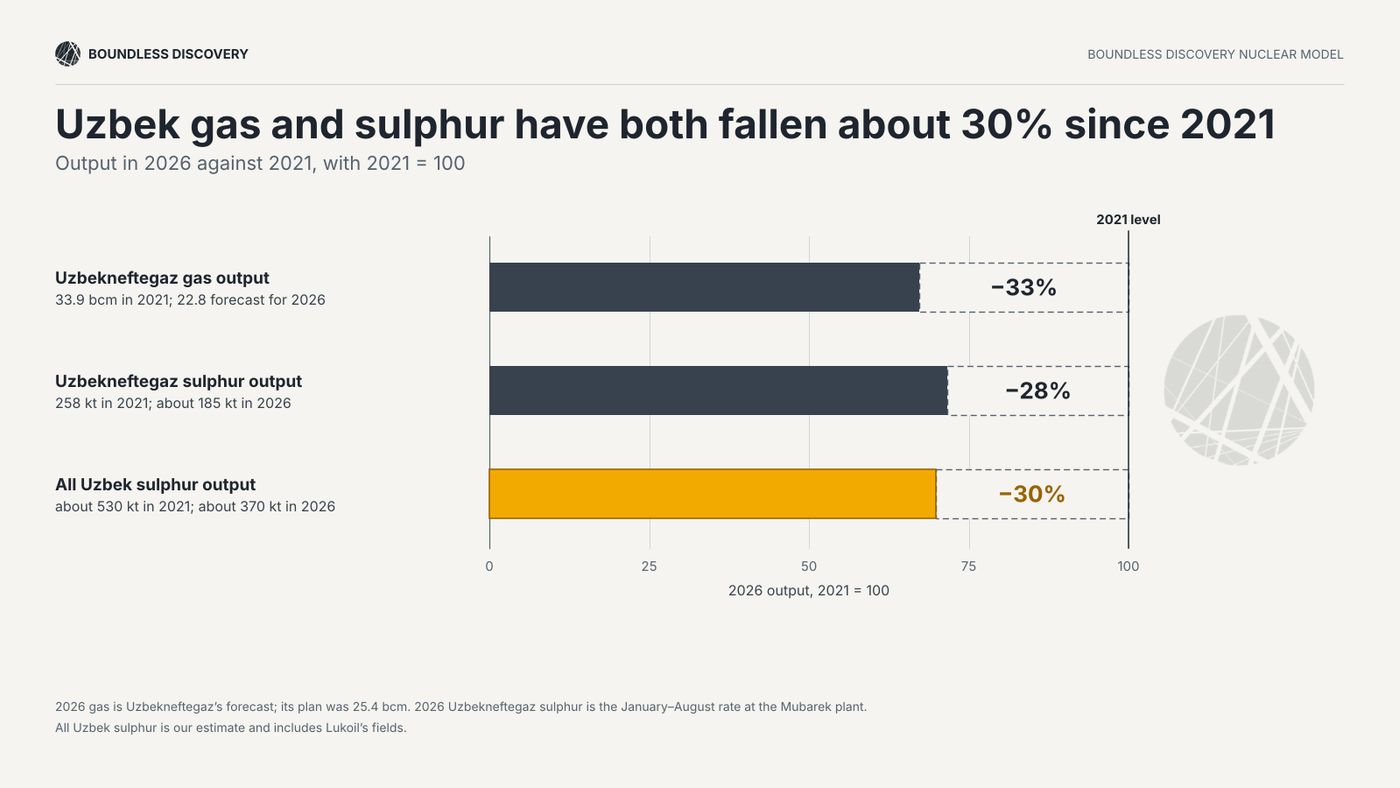
Uzbekistan is replacing the lost gas with imports, and imported gas carries no sulphur: it arrives already cleaned, and the sulphur stays where the gas was processed. Gas imports from Russia and Turkmenistan rose 15% by value in January-August. Russian deliveries alone rose from 5.6 to 6.5 billion cubic metres in 2025, and the IEA expects more than 10 billion this year.
Our estimates imply that Uzbek gas yields about 10,000 tonnes of sulphur per billion cubic metres, both in 2021 and now. At this year’s rate of decline, about 7 billion cubic metres a year, the country loses about 70,000 tonnes of sulphur annually, enough acid for roughly 1,000 tonnes of uranium. Each year the decline continues, Uzbekistan must import another 70,000 tonnes just to stand still.
The one potential new source of sulphur is the Boysun gas field. We estimate it could, in time, yield more sulphur than Uzbekistan produces today. It was due to start production in 2024. Instead, a blowout at well 604 in September 2024 killed four people. China’s CNPC began sealing the well in August 2026 and expects to finish in July 2027. No production date has been set.
At Home, The Supplier is Lukoil
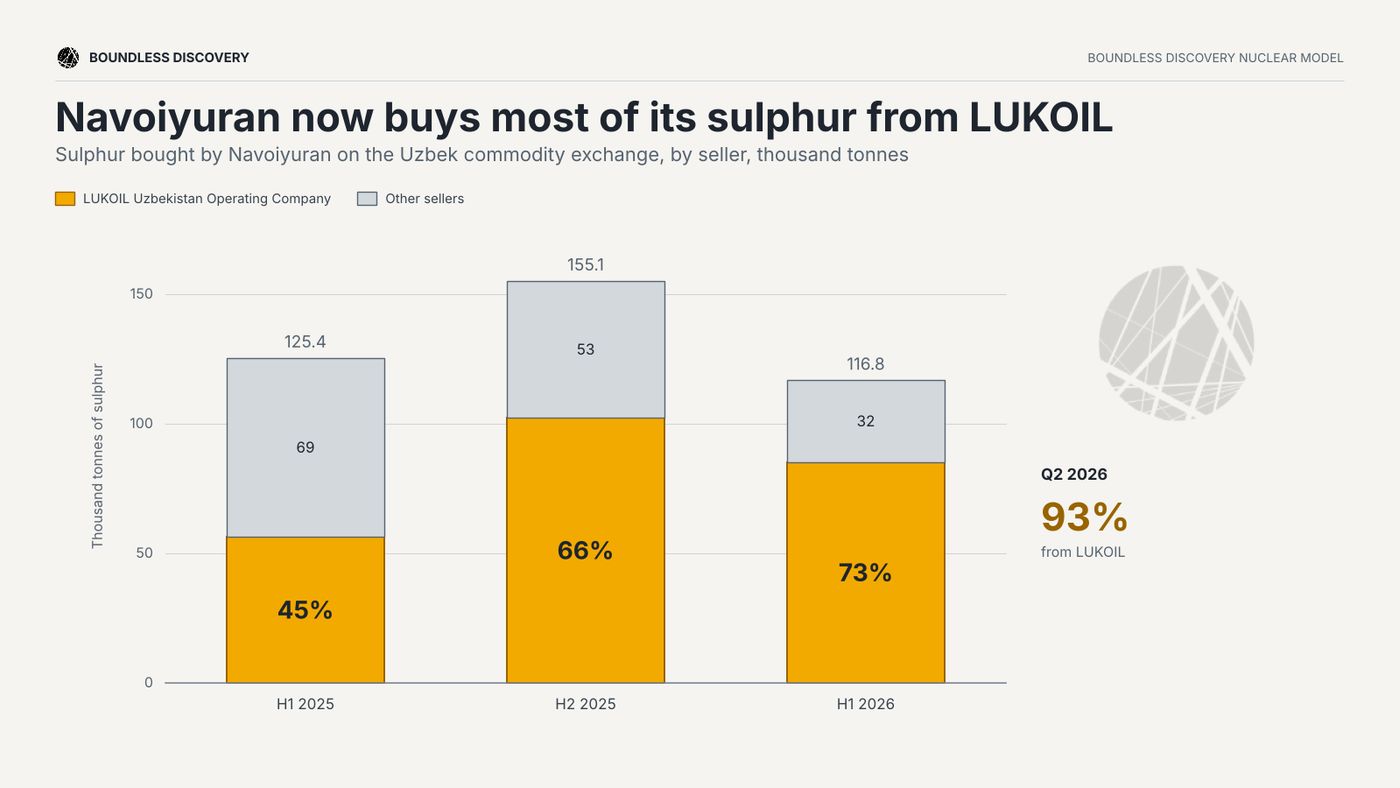
Most of the sulphur Navoiyuran can still buy at home comes from Lukoil, Russia’s second-largest oil producer. Our analysis of all disclosed sulphur sales on the Uzbek commodity exchange shows Lukoil’s share of Navoiyuran’s exchange purchases rising from 45% in the first half of 2025 to 73% in the first half of 2026, and to 93% in the second quarter (Figure 13). Navoiyuran now buys about 170,000 tonnes a year from Lukoil. By our estimate, this is most of what Lukoil’s Uzbek fields produce.
Lukoil also has a record with Uzbek regulators. In 2024, the Competition Committee found its trading company had distorted exchange volumes, pushing technical-sulphur prices up 10-50% on average, and ordered it to return the gains.
Lukoil has been under full US blocking sanctions since 22 October 2025. Its Uzbek business belongs to Lukoil International, which holds its foreign assets and operates under OFAC General License 131J. The licence allows negotiations to sell Lukoil International and lets its subsidiaries continue operating in the meantime. This version, the eleventh since November 2025, expires on 22 October. Carlyle, the most advanced bidder, withdrew on 9 October after its January agreement lapsed without OFAC approval. A consortium led by the American investor Todd Boehly is still bidding, and the US International Development Finance Corporation would reportedly take about 15%. If that deal goes ahead, the US government’s vehicle for securing critical minerals would hold a stake in one of Navoiyuran’s most important suppliers.
Tashkent, meanwhile, is acting as if Lukoil will stay. On 6 October, President Mirziyoyev met Lukoil’s founder, Vagit Alekperov, to discuss expanding its work in Uzbekistan.
If the licence lapses without a sale, Navoiyuran must either replace Lukoil’s sulphur with imports or keep paying a company the US treats as blocked, which would expose it to secondary sanctions. That matters to its Eurobond holders, prospective IPO investors and the utilities that buy its uranium. The licence is likely to be extended, but the more certain problem is depletion: by our estimate, gas from producers other than Uzbekneftegaz, mostly Lukoil, fell by about a quarter in January-August. A sale would remove the sanctions risk but not the shortage.
The Copper Smelter Will Not Arrive Before 2030
Almalyk’s new copper smelter is the largest single fix for both constraints, because it makes acid without sulphur. The USD 2.55 billion plant is designed to produce 1.8 million tonnes of acid a year, a net gain of about 1.4 million after older capacity retires. In January 2025, Almalyk’s chairman expected completion in 2027. Its quarterly investment disclosures also said 2027, until the one published on 14 October, which says 2029.
Even 2029 looks early:
- In the third quarter of 2026, Almalyk reported USD 1.5 million of construction work on the smelter, 0.06% of its cost.
- Construction of the acid plant and smelting shop had not started.
- In September, it was still asking firms for preliminary proposals to manage construction.
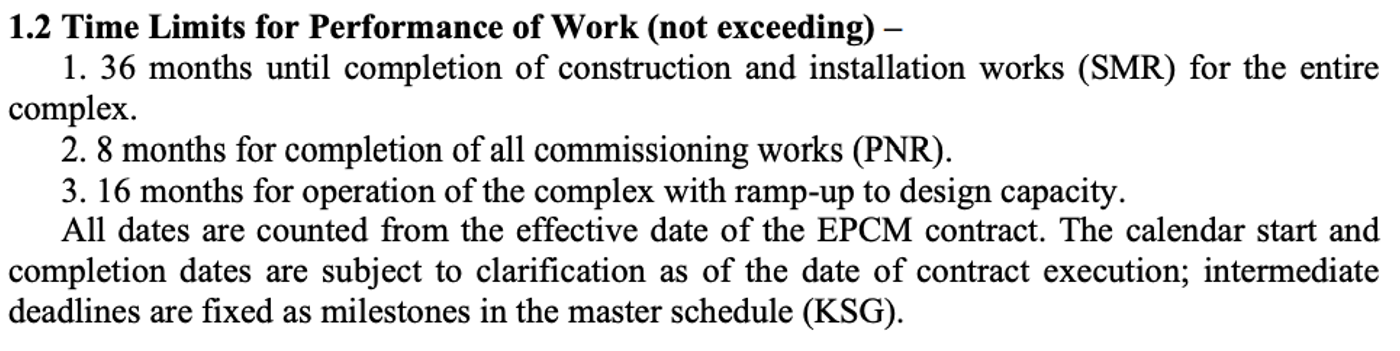
The tender terms in Figure 14 give that manager up to 36 months to build, eight to commission and 16 to reach full output. Signed at the start of 2027, that means commissioning in late 2030 and full output in early 2032; a later signing pushes both back. The 2030 target has to be met without the smelter.
Why It Cannot Easily Import It
Uzbekistan’s 100% export duty on sulphur, in place since 1 July 2025, keeps domestic sulphur at home, where buyers bid only against each other. Russia banned sulphur exports in November 2025 after Ukrainian strikes on its Astrakhan and Orenburg gas plants, and has extended the ban to the end of 2026. It exempts members of the Eurasian Economic Union; Uzbekistan is an observer, not a member. Then the closure of the Strait of Hormuz, which normally carries about half the world’s seaborne sulphur, more than doubled world prices by June.
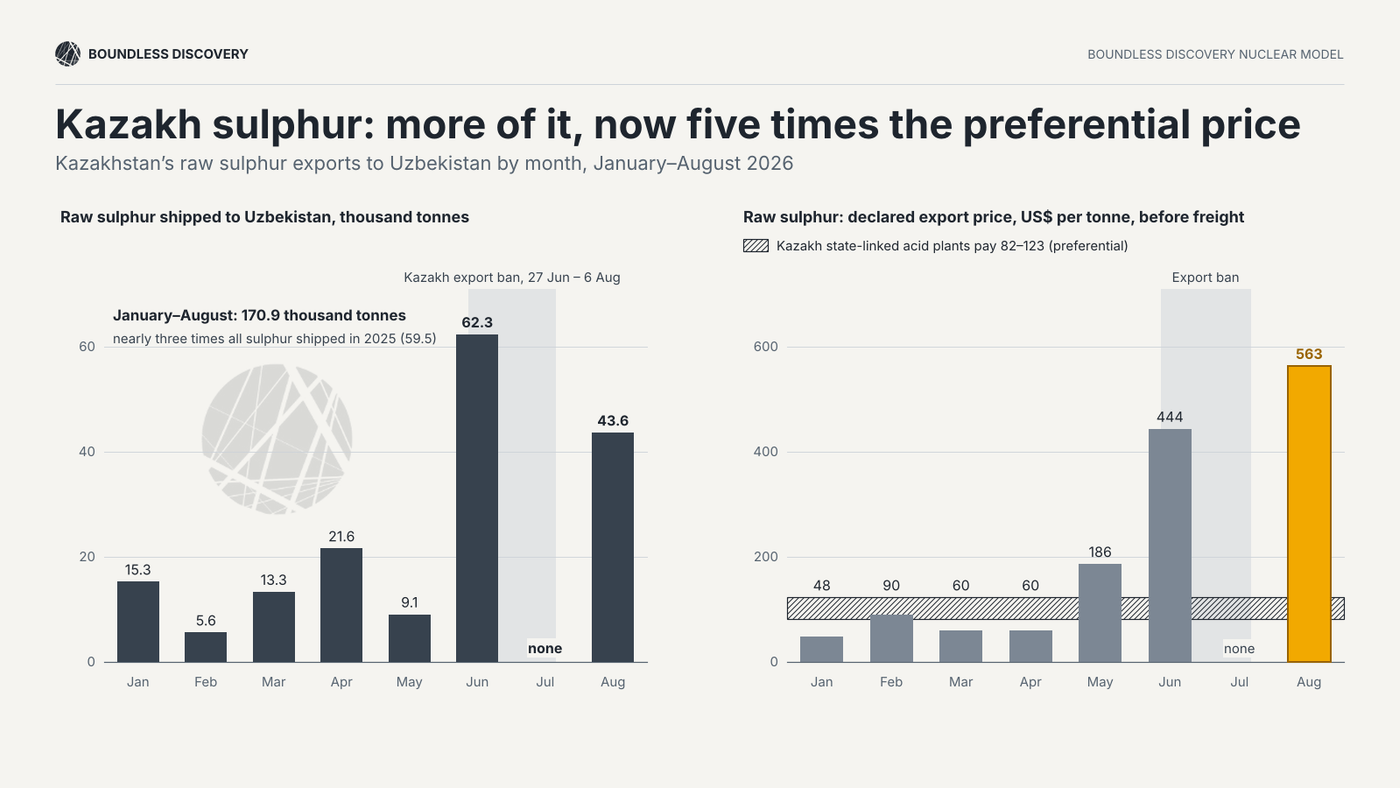
Kazakhstan has filled part of the gap, shipping 170,900 tonnes of raw sulphur to Uzbekistan in January-August 2026, nearly three times as much as in all of 2025. On 26 June, Kazakhstan’s energy ministry suspended sulphur exports to every destination except Russia; the restriction was cancelled on 6 August. Shipments have since resumed, at a much higher price (Figure 15).
What Imported Sulphur Costs
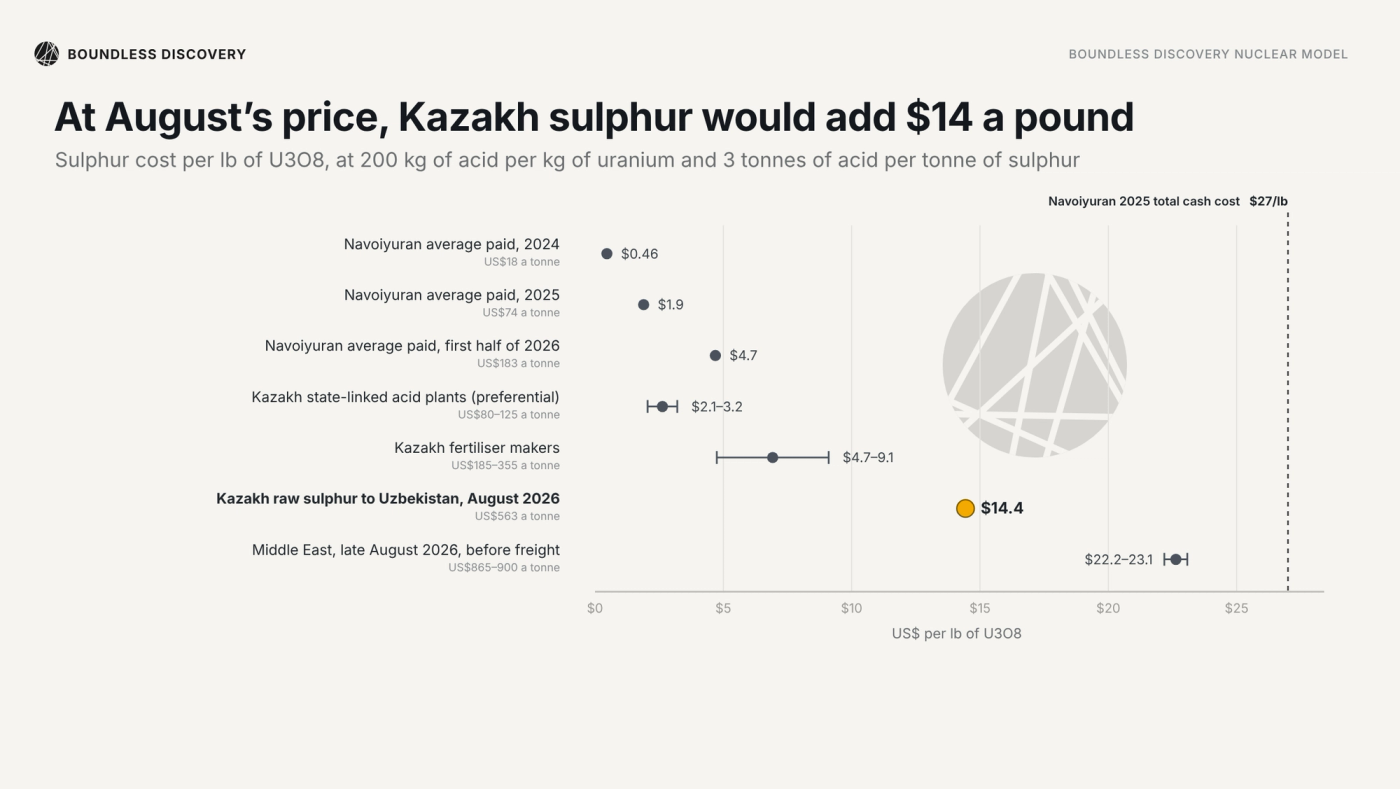
Even at home, the average price Navoiyuran paid rose from USD 18 a tonne in 2024 to USD 74 in 2025 and USD 183 in the first half of 2026. Kazakh sulphur delivered to Uzbekistan cost USD 563 a tonne in August.
Kazakhstan does not charge every buyer the same. In May 2026, a member of its parliament said Tengizchevroil, the country’s largest oil producer, sells sulphur for acid-making to companies of the Samruk-Kazyna state fund, which also holds most of Kazatomprom, at about USD 80–125 a tonne under arrangements running to 2031. The fertiliser makers Kazphosphate and EuroChem-Karatau pay about USD 185–355. Uzbek importers pay more than either.
Each tonne of sulphur makes about three tonnes of acid. At 200 kg of acid per kilogram, every USD 100 on a tonne of sulphur therefore adds about USD 2.50 to each pound of U3O8 made with that acid. At the 2024 price of USD 18, sulphur added under USD 0.50 a pound. At August’s Kazakh price of USD 563, it would add about USD 14, more than half of Navoiyuran’s 2025 total cash cost of USD 27 (Figure 16).
In October 2025, the President asked Navoiyuran to cut production costs by up to 40%. Sulphur is moving them the other way.
That squeezes margins; at current uranium prices it does not by itself stop growth. What limits growth is whether the tonnes can be bought at all.
Kazakhstan: The Main Supplier, and The Main Competitor
With Russian sulphur unavailable, the obvious source is Kazakhstan, which produces about 4–4.5 million tonnes of sulphur a year, more than ten times Uzbekistan’s output. It will not be cheap. More importantly, Kazakhstan’s government owns 75% of Kazatomprom, Navoiyuran’s largest competitor, which has deliberately held back output to support prices. Navoiyuran’s expansion resembles Kazatomprom’s own push for volume after 2008, which helped drive uranium to $18/lb in 2016. Kazakhstan would be selling sulphur to a competitor running the strategy Kazatomprom has abandoned.
Turkmenistan: Sulphur Next Door, Little Bought So Far
Turkmenistan is the other neighbour with sulphur to sell. Turkmengaz recovers it from the Galkynysh field, whose gas is up to 6% hydrogen sulphide, and sells it on the Ashgabat commodity exchange. The US Geological Survey estimates Turkmen output at 870,000 tonnes in 2023. Most of it normally goes by rail through Iran to Bandar Abbas, on the Strait of Hormuz, for shipping overseas. With commercial traffic through the strait almost at a standstill, that route is largely shut. The exchange still found buyers in early October, from Türkiye, the UAE and Singapore.
As far as we can see, Uzbekistan has bought only a few thousand tonnes this year. Yet Galkynysh is closer by rail than Tengiz to every one of Navoiyuran’s acid plants, and Galkynysh gas already crosses Uzbekistan on its way to China. The nearest sulphur in the region is the sulphur Uzbekistan buys least of.
Even With Sulphur, Growth is Expensive
Doubling output means opening new fields continuously, and each consumes acid for months before it produces much uranium. This is one reason the acid needed per kilogram rose in every period Navoiyuran disclosed.
Drilling also has to keep doubling. Navoiyuran drilled about 770 metres of production wells for each tonne it produced in 2025. At that rate, 15,000 tonnes would need about 11.6 million metres a year, twice last year’s 5.4 million. Drilling rose 127% in 2025 while output rose 35%, though part of last year’s drilling will only produce this year. Navoiyuran’s review of the first nine months of 2025 already called for better wells and more qualified crews, and it does not publish the capacity of its processing plants. Its JORC reserves of 96,600 tonnes equal about six and a half years at 15,000 tonnes a year; for an in-situ leach miner that converts resources continuously, that is a planning horizon rather than a ceiling.
Chemistry is the main unknown. In April 2026, Navoiyuran began commercial production at Qizilkok, a 1,200-tonne-a-year deposit, using what it calls low-reagent leaching with oxygen. It says it is introducing oxygen and carbonate leaching to cut its dependence on acid, and the carbonate that makes Uzbek ore expensive to leach with acid suits alkaline leaching. But oxygen leaching is already in use at other deposits, so some of the saving is already reflected in the acid figures. Qizilkok is 8% of the 2030 target, and Navoiyuran has not disclosed how much acid the method saves. If it works at scale, it lowers every acid and sulphur figure in this piece.
Uzbek Uranium Is Now a By-Product Business
The most pressing limit to Navoiyuran’s growth is not ore. It is the sulphur left over when Uzbekneftegaz and Lukoil clean their gas, and the acid left over when Almalyk smelts copper. Navoiyuran controls neither.
The state decides who gets them, and it has already chosen once. When acid ran short this year, it prioritised uranium, all of it exported, over fertiliser, most of which goes to Uzbek farms. The impending shortage is sulphur, and the same choice will come round again, against a fertiliser target that also needs more acid. Those forecasting Uzbek supply and the cost of production should watch fertiliser demand, gas output, sulphur imports and Almalyk’s new copper smelter, not just drilling rigs or the conversion of resources to reserves.
__________
Interested in the model behind this analysis?
Boundless Discovery has built and maintains a comprehensive digital twin of the global uranium and nuclear markets, combining market data, asset-level intelligence and proprietary research.
We provide institutional access to this model for investors, operators and other market participants seeking a deeper information advantage across the sector.
Contact our team to learn more about institutional access: https://www.boundlessdiscovery.com/connect