
Highlights
- Five years ago, Uzbekistan sold off a sulphur stockpile which could have fuelled years of Navoiyuran’s expansion. Now Uzbekistan turns from exporter to importer and its biggest competitor is its main supplier. Kazakhstan supplies almost all of its imports, and Uzbekistan will need to import more next year as its sulphur-producing gas fields decline. By 2027, Boundless Discovery estimates it will be one of the world's 15 largest sulphur importers.
- Drones have struck Russia’s Astrakhan gas plant, the largest sulphur source within rail reach of Uzbekistan. It has been hit six times since February 2025, and Russia has banned sulphur exports, extending the ban each time it was due to lapse.
- Boundless Discovery examined the major exposed sulphur stockpiles within reach of Navoiyuran on satellite images: none at the gas plants is growing, and most are at decade-long lows. Exposed sulphur at Navoiyuran’s acid plants is not growing either.
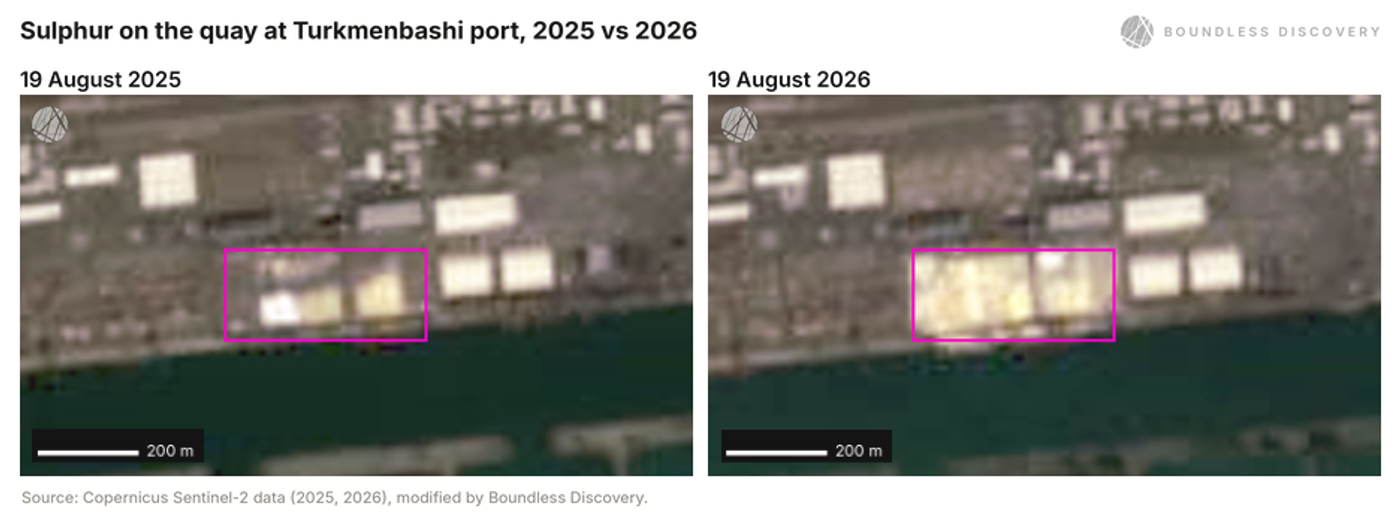
- Turkmenistan, next door, could free Uzbekistan from Kazakh sulphur, but its sulphur is going the other way. When the Strait of Hormuz closed its route south through Iran, Turkmen sulphur moved west across the Caspian instead. Satellite images show stock amassing on the quay at Turkmenbashi port. Buyers abroad, from Brazil to Singapore, are competing for it, and in October, prices were quoted at almost four times what Navoiyuran pays for sulphur at home.
In October, Boundless Discovery reported that sulphur availability and pricing will pressure Uzbekistan’s uranium growth. Since then, we have looked at all the nearest major sources from which its state miner, Navoiyuran, will get its sulphur. The search led us to a Russian gas plant under drone attack, a Turkmen port shipping more sulphur west, and its biggest uranium rival, Kazakhstan, which now supplies nearly all of Uzbekistan's imports.
"Sulphur abroad is hard to find," we wrote on 20 October. This report shows why.
Uzbek Sulphur Imports Must Rise
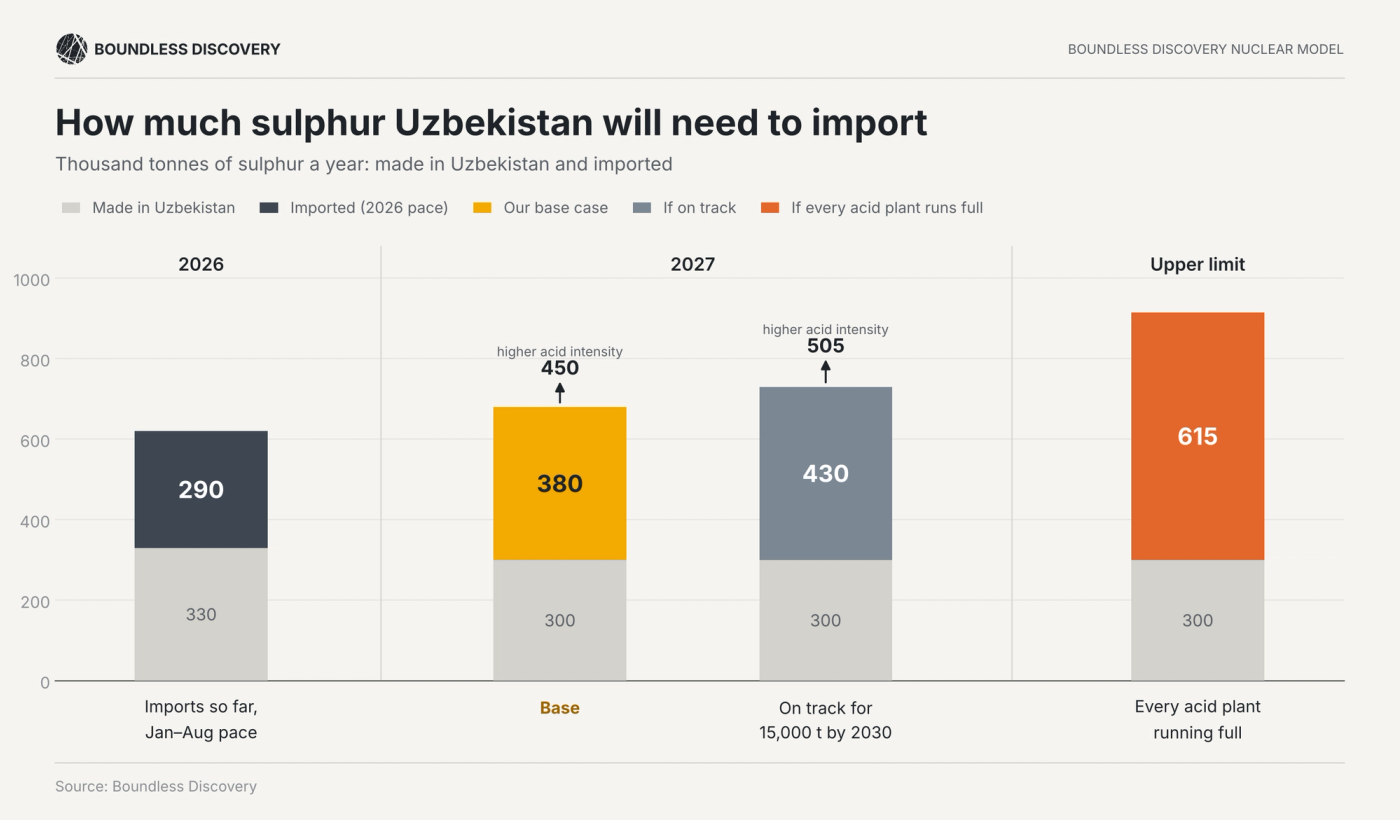
In 2021, a year before the government set its first 2030 uranium target, Uzbekneftegaz sold off two-thirds of its sulphur stockpile at Mubarek. Five years on, Uzbekistan is now importing sulphur at a rate of about 290,000 t a year, up from almost nothing at the start of 2025. Its uranium ambitions will need more. As Navoiyuran mines more and the domestic gas fields make less, we estimate imports will reach about 380,000 t in 2027, and about 430,000 t if Navoiyuran is on track for the government’s target of 15,000 t by 2030. Once the acid plants now being built run at capacity, Uzbekistan would need about 615,000 t a year, more than twice what it buys today (Figure 1).
Navoiyuran has not published a 2027 target; we assume 9,000 t of uranium, 1,000 t more than its 2026 target, which needs about 60,000 t more sulphur. A straight line from 8,000 t in 2026 to 15,000 t in 2030 gives 9,750 t in 2027, which needs about 110,000 t more. Uzbekistan’s own output is falling with its gas: Uzbekneftegaz made 340,000 t of sulphur in 2021 and is on course for about 180,000 t this year. Some of this year’s imports may be going into stock ahead of new acid plants, which would make our 2027 figures too high. Higher acid intensity would push them the other way: if Navoiyuran uses as much acid per kilogram of uranium as it did in early 2025, imports rise to about 450,000 t.
Boundless Discovery checked every large source of sulphur that can reach Navoi by rail: Uzbekistan’s own gas plants, Kazakhstan, Turkmenistan and Russia. China, the world’s largest sulphur importer, needs all it can get and is unlikely to sell. Anything else would have to come through Iran, and almost none has: Kazakhstan supplied virtually all of Uzbekistan’s imports this year. We tracked seven sulphur yards, three acid plants and one port on satellite images over the past decade, and measured pile heights with a laser-ranging satellite. We read customs records from Kazakhstan, Uzbekistan and 11 importing countries, filings by Kazakh oil producers, and Russian and Ukrainian accounts of six drone strikes.
The sources have been hit by drones, sold down or shipped around the world. Unless Uzbekistan outbids traders for Turkmen sulphur, its extra imports will depend on Kazakh output.
Russia's Sulphur Is Behind a Ban and Under Fire
The largest sulphur source within rail reach of Uzbekistan is Gazprom's Astrakhan gas plant, which can make about 5 million tonnes a year, more than 60% of Russian output. Russia has barred sulphur exports since early November 2025 and has extended the ban each time it fell due, now to 31 December 2026. Members of the Eurasian Economic Union, including Kazakhstan, are exempt; Uzbekistan, an observer, is not. Its only opening is a 300,000 t permit quota from 21 August, for low-grade “grade 7000” sulphur, about 70% pure, which sulphuric acid makers avoid: the impurities foul an acid plant’s sulphur burners and catalyst.
This plant is also in Ukraine’s crosshairs. Ukrainian drones have hit it at least six times in 20 months, the last two times on the very units that strip hydrogen sulphide from the gas: on 24 August and on 4 October. Satellite imagery from late on 4 October caught smoke drifting from the attack (Figure 2).
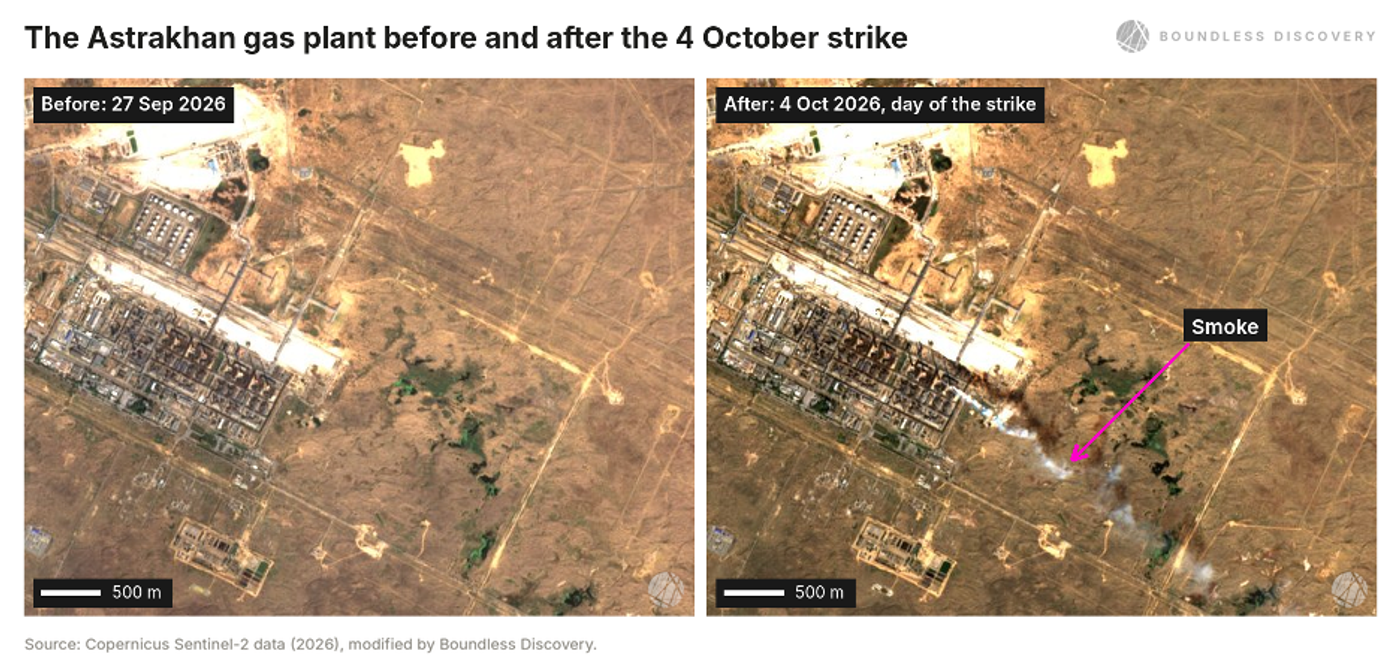
Astrakhan’s governor confirmed two of the strikes on the plant and attacks on unnamed industrial sites on the dates of two more. The August and October strikes rest on Ukraine’s military, and our imagery shows smoke in October.
The strikes are likely to continue. Ukraine paused attacks on Russian refineries in late October at Washington's request, as Russian diesel headed for the US; within 72 hours its drones had hit three more.
Every Sulphur Stockpile in Reach Is at or Near Its Lowest
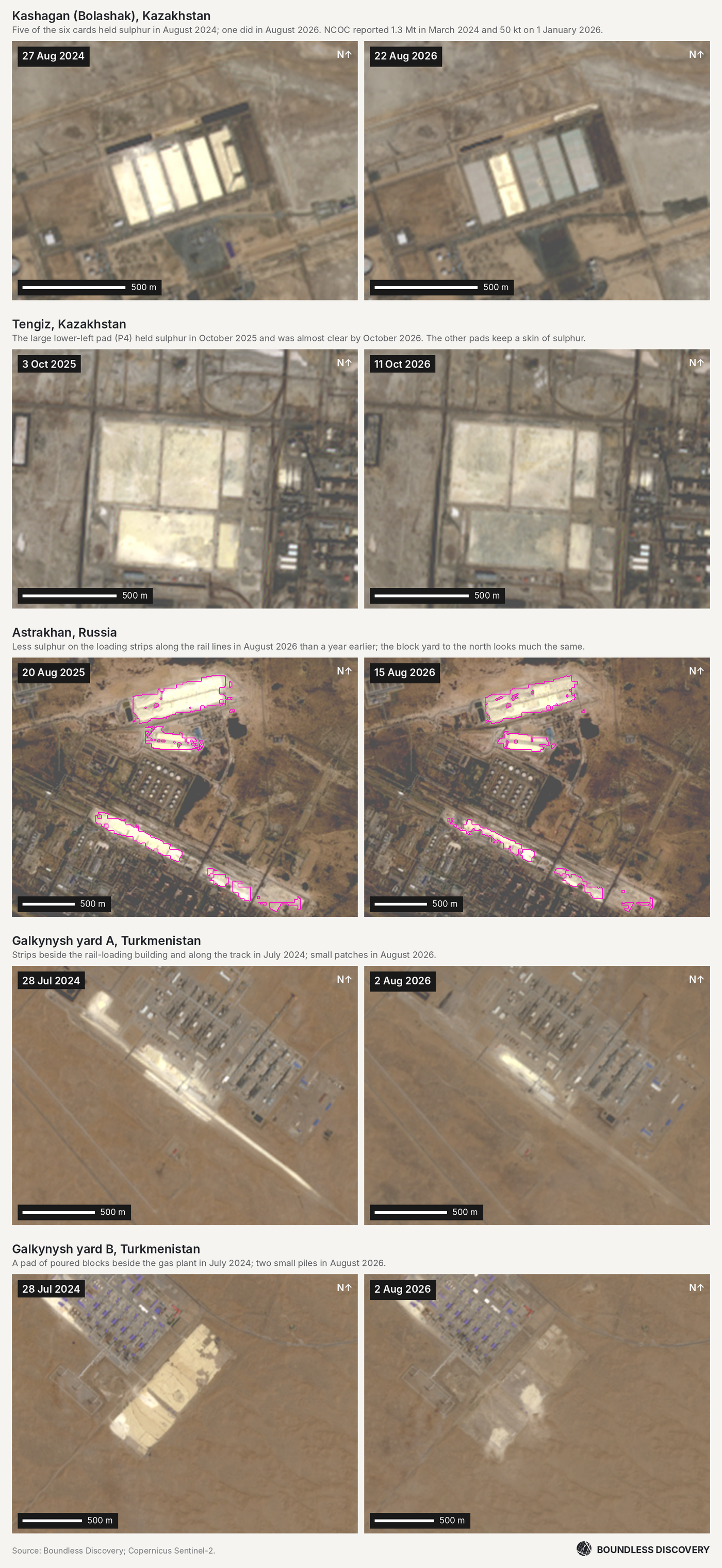
Boundless Discovery measured every exposed sulphur stockpile within rail reach of Uzbekistan's acid plants on satellite imagery, comparing each with its own history in our measurements, which go back to 2017 at most sites (Figure 3). None of the stockpiles at the gas plants are growing, and most are at or near their lowest.
Uzbekistan: The Main Stockpile is the Smallest Since 2018
The stocks that matter most are Uzbekistan's own, because sulphur bought at home costs a fraction of imports thanks to a 100% duty on exports. Navoiyuran paid an average of USD 183/t on the Uzbek exchange in the first half of 2026; Kazakh sulphur cost USD 563/t in August.
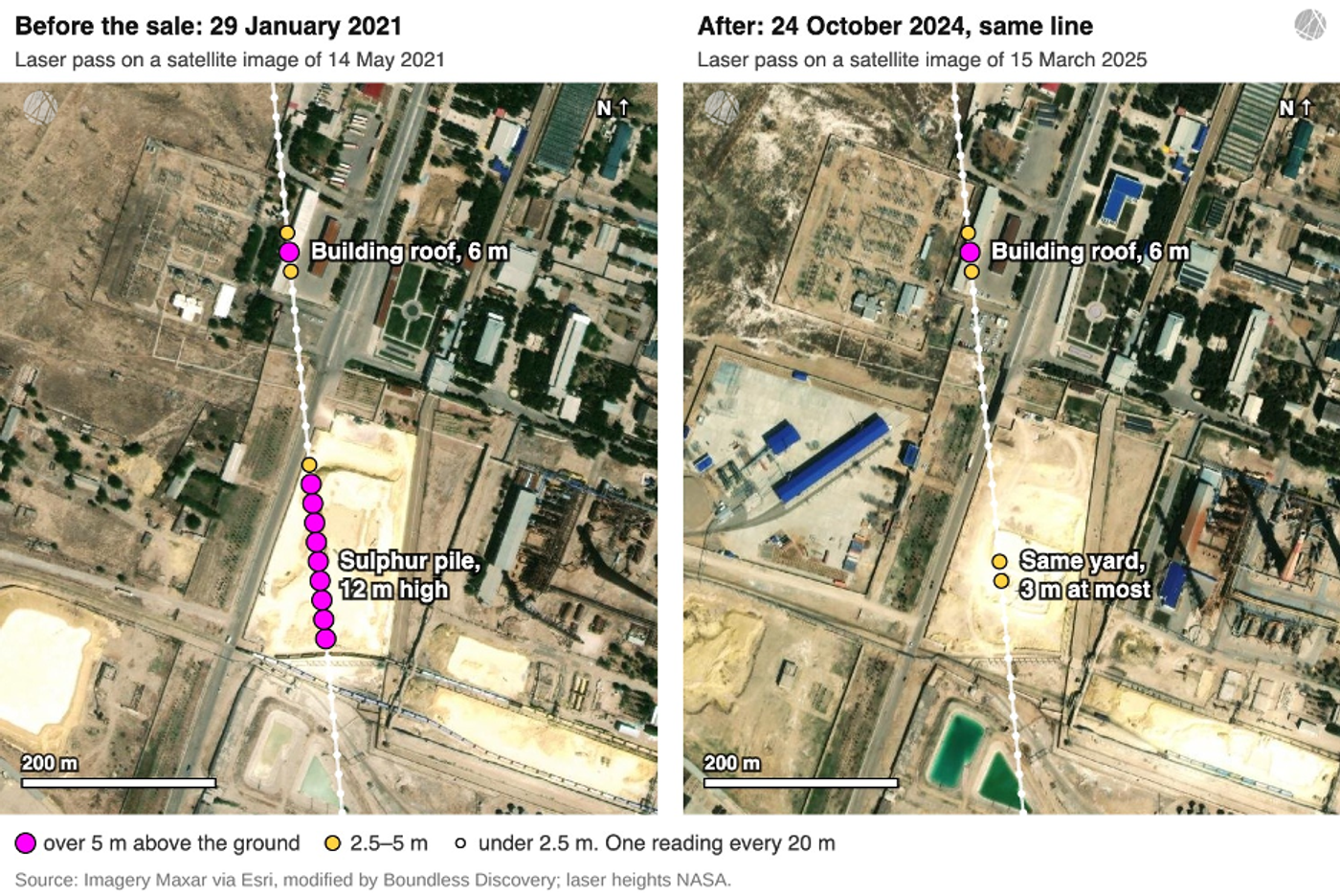
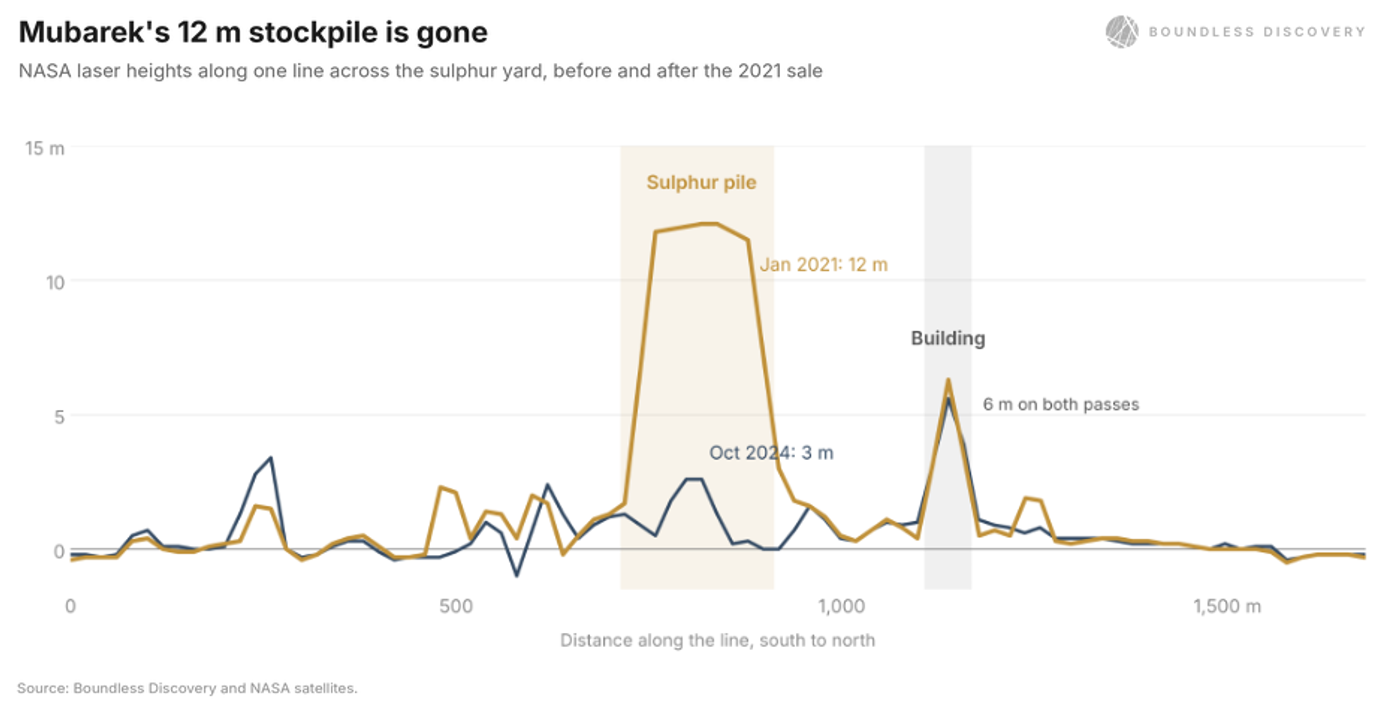
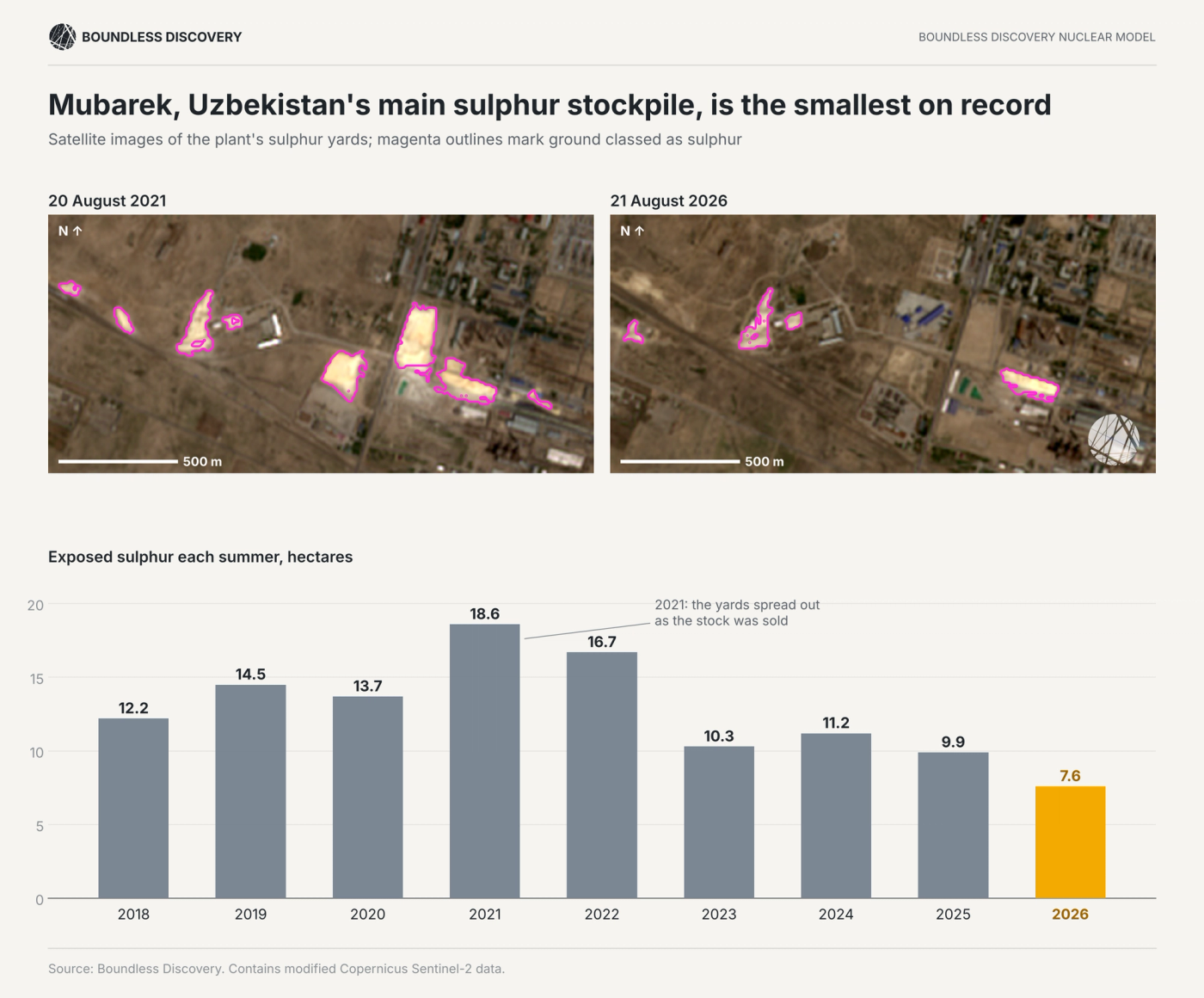
Mubarek is the country's main stockpile. It held 724,500 t on 1 January 2021. Then Uzbekneftegaz sold about two-thirds of it that year. Laser-ranging satellites catch the sale by measuring height: a 12 m pile in January 2021 was gone by July (Figure 4), while the exposed area grew, because sales spread the piles out for loading.
Since then, its visible area has fallen in every year but one, to 7.6 ha this summer, the smallest since our record begins in 2018 (Figure 6). Uzbekneftegaz is making about 180,000 t of sulphur this year, against 340,000 t in 2021, as its sour gas declines. Lukoil's Kandym plant keeps its cells full and sells as it makes: this is a flow to Navoiyuran, not a buffer.
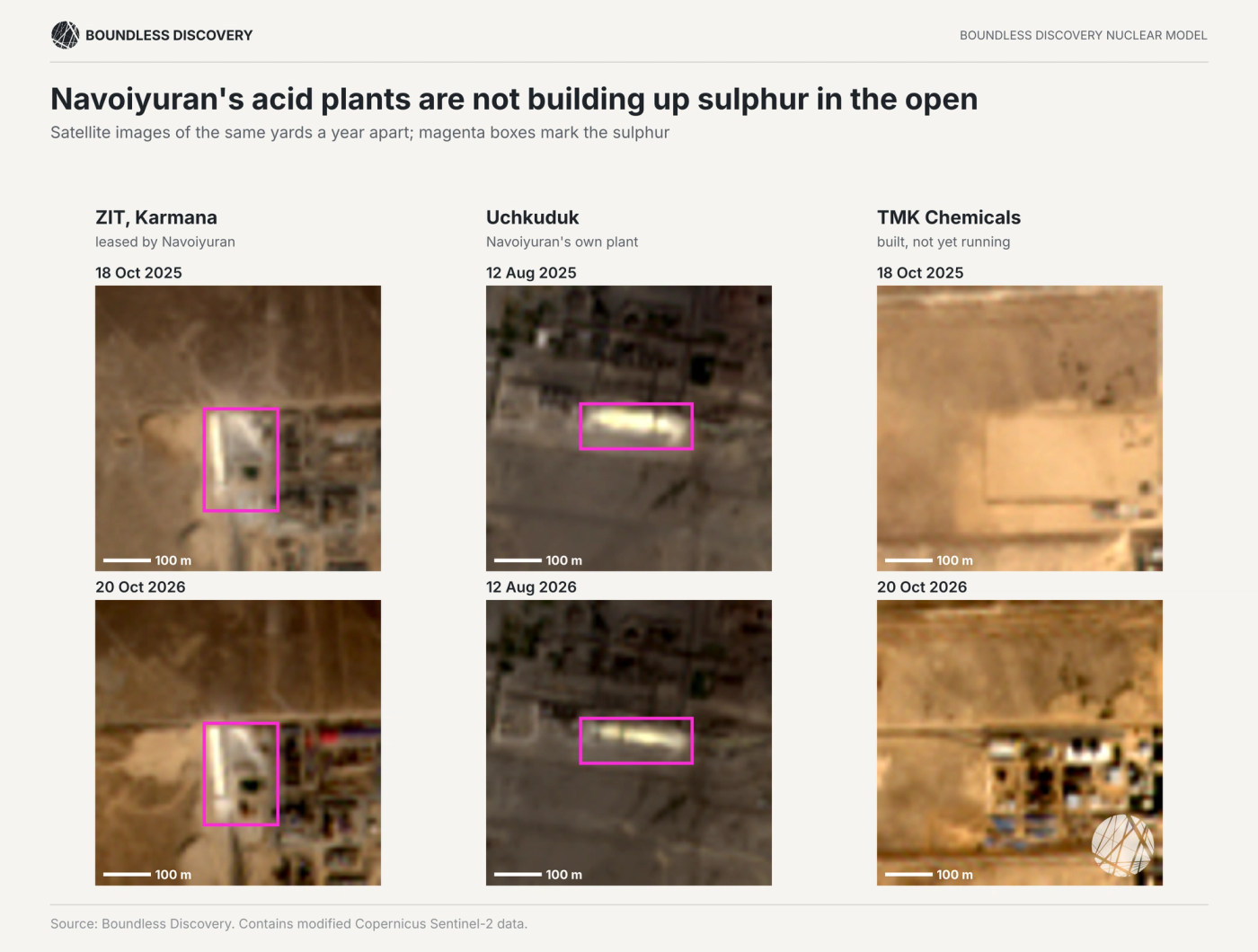
Navoiyuran's own acid plants do not appear to be amassing stocks either. The exposed sulphur at the ZIT plant it leases at Karmana is no larger than in 2025, and at its own plant at Uchkuduk it has shrunk; we are watching both. TMK Chemicals' new acid plant next to ZIT, which is also likely to supply Navoiyuran and will also need sulphur, has not started and holds no sulphur in the open (Figure 7).
Turkmenistan: The Hormuz Closure Sent its Sulphur West
Galkynysh makes over 1 Million tons of sulphur a year and is about 420 km from Navoi. This summer, its two yards held only a fraction of the exposed sulphur visible in summer 2024 (Figure 3). Importers' customs records show where it went.
In 2025, importing countries reported substantial purchases of Turkmen sulphur. UN Comtrade-based estimates put exports at approximately 504,000 tonnes, led by Brazil (193,000 tonnes), Egypt (171,000 tonnes), China (98,000 tonnes) and Morocco (42,000 tonnes). These are likely not complete figures, but they establish the scale of competition for Turkmen supply.
Much of Turkmenistan's sulphur has traditionally moved south through Iran to international markets. That route was severely disrupted after the Strait of Hormuz closed on 28 February 2026. By March, shipments were being redirected west across the Caspian to Azerbaijan, then by rail to Georgia's Black Sea ports at Poti and Batumi.
The logistics shift since the Hormuz closure can also be seen from above on the quay at Turkmenbashi (Figure 8).
Turkmenistan’s sulphur trade barely slowed. Importers reported 255,000 t from Turkmenistan in January-August, about the same as a year earlier. In January-July, importers' own customs show Brazil taking 105,700 t, Egypt 81,500 t to April, Kazakhstan 24,400 t and Indonesia 22,600 t. Uzbekistan reported 7,900 t, all of it in May-July. We have not traced individual cargoes, and Iran and Afghanistan do not report, so Uzbekistan's true share is, if anything, smaller.
Turkmen sulphur is not cheap either. On 8 October, Turkmengaz sold USD 138 million of lump sulphur on the Turkmen commodity exchange to buyers from Singapore, the UAE and Türkiye; the exchange did not publish tonnes or prices. Two weeks later, a broker was offering Galkynysh lump sulphur at USD 680/t at the plant gate. That is about USD 17 a pound of uranium before freight, against USD 14 for Kazakh sulphur imported by Uzbekistan in August. Uzbek buyers could bid, but they would be competing with international traders.
Kazakhstan: Ten Times the Price, From a Uranium Rival
Kazakhstan's sulphur buffer has been sold down. Kashagan's operator, NCOC, was fined USD 5.1 bn for storing 1.75 Mt of sulphur where it was permitted 0.73 Mt, and sold its stock down from 1.3 Mt in March 2024 to 50,000 t on 1 January 2026, according to its filings. Its 2026 plan sells most of its 1.53 Mt as it is made. At Tengiz, the largest pad lost its exposed sulphur between March and May 2026.
NCOC sold 2.08 Mt in 2025, and it was cheap: Kazakhstan's sulphur exports to Uzbekistan that year averaged about USD 50 a tonne. Uzbekistan bought 59,500 t, and only 3,200 t of it before September. It missed the sale months before it needed the sulphur.
What remains is current output, and Uzbekistan is paying more for it. Kazakhstan shipped 183,500 t of sulphur to Uzbekistan in January-August 2026: about 96% of Uzbekistan's imports. It declared those exports at USD 48/t in January and USD 516/t in August, more than ten times as much (Figure 9). In January-August, it earned USD 60.6 m from them, 20 times its total for 2025. Kazakhstan suspended exports to every destination but Russia from 27 June to 6 August, and Russia, which barred Kazakh sulphur from its railways on 24 May, lifted the ban on 24 July, so Kazakh sellers again have a route north to world markets. Uzbek buyers will be bidding against them.
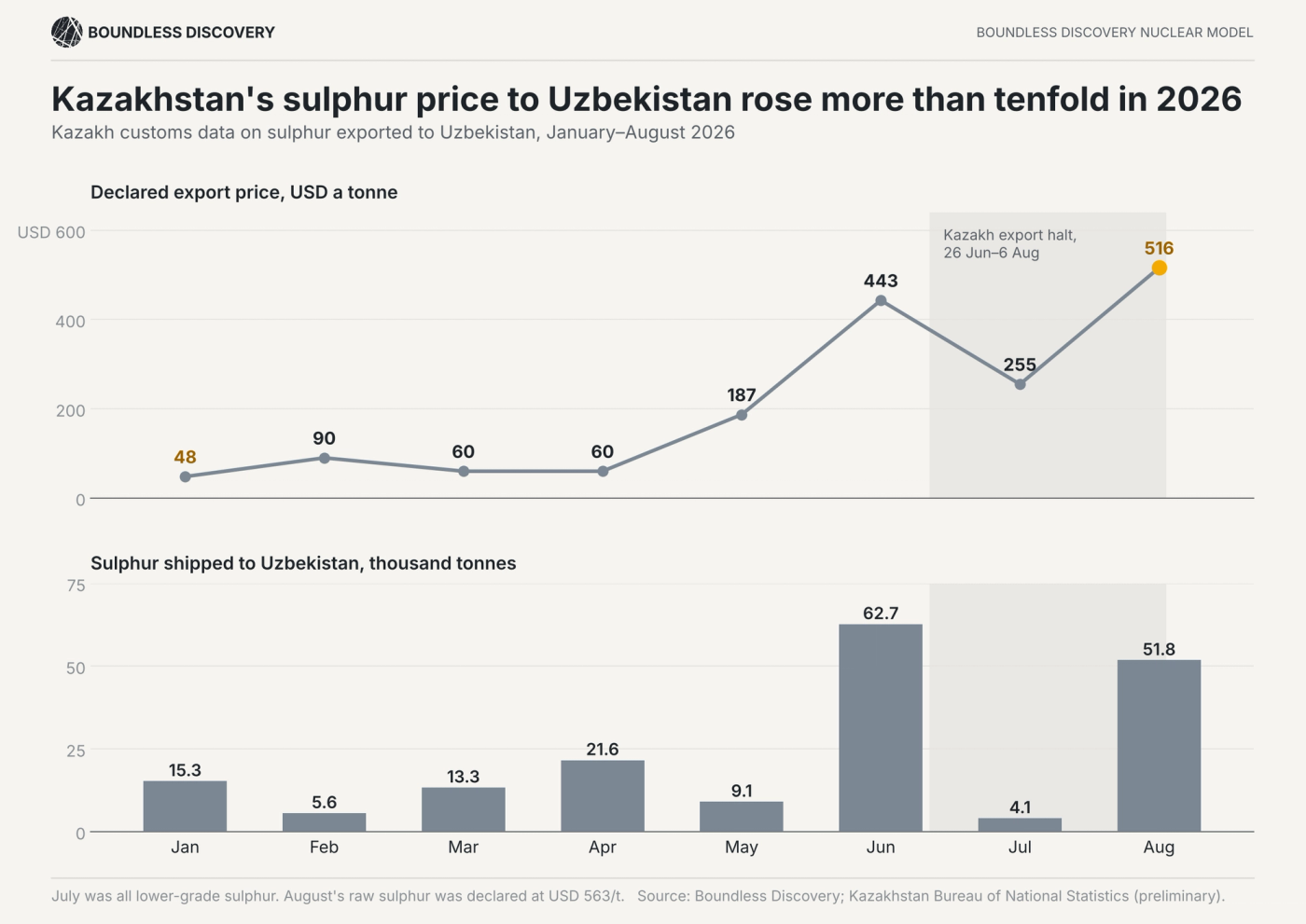
The sellers will likely know what the sulphur is for. Samruk-Kazyna, the state fund that owns 63% of Kazatomprom, the world's largest uranium producer, also owns the companies that get Tengiz's sulphur first, at USD 80-125/t, as the Acid Test showed.
Navoiyuran's Incremental Tonne of Uranium Runs on Kazakh Sulphur
Uzbekistan had one large buffer, at Mubarek, and sold most of it in 2021. The region's largest, at Kazakhstan's Kashagan field, was sold off after a USD 5.1 bn fine, and almost none of it went to Uzbekistan. Both are gone. From 2027, every extra tonne of Navoiyuran's uranium must be fed largely from current output, and most of the output in reach is Kazakh. The rest is Turkmen, which Uzbekistan has never bought in volume.
That does not mean Uzbekistan will run short. Kazakhstan makes about ten times what Uzbekistan must import. It means Uzbekistan buys on Kazakhstan's terms. In 2026 Kazakhstan stopped exports for six weeks, and the declared price of its sulphur to Uzbekistan rose from USD 48/t to USD 516/t, still about half what Kuwait's state oil company charged in July, about USD 950/t. Each pound of uranium (as U3O8) needs about 26 kg of sulphur. At August's declared Kazakh price of USD 563/t that is about USD 14 a pound in sulphur alone, against about USD 5 at the USD 183/t Navoiyuran pays at home which was only USD 1 at January's prices this year. At Kuwait's July price, it would be about USD 24, a quarter of uranium’s spot price. A model that prices Navoiyuran's growth at home prices is using the wrong number (Figure 10).
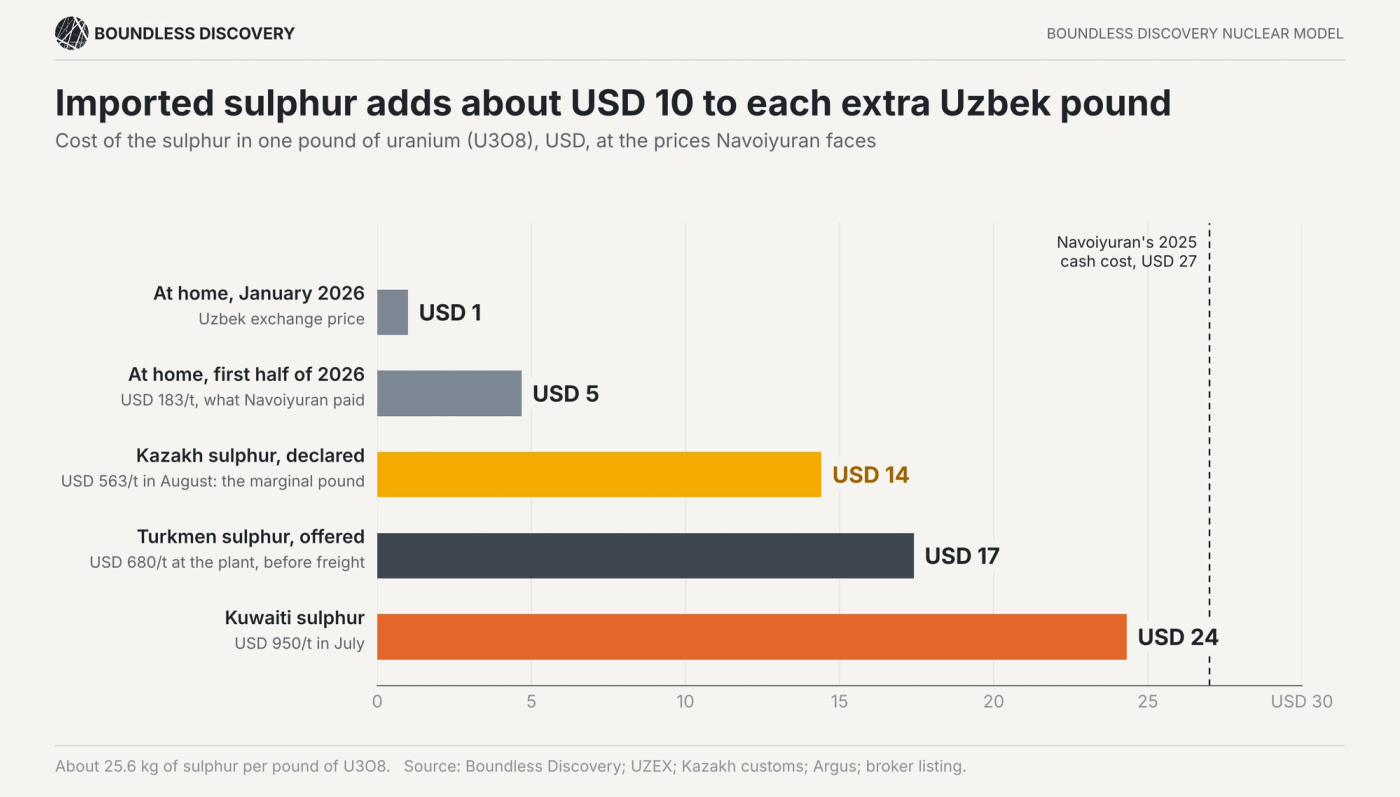
Uzbekistan mined 7,000 t of uranium in 2025, a quarter of Kazakhstan's output, and has set a target of 15,000 t by 2030. If the country is unable to recover and grow its gas and thus sulphur production, more of those pounds will carry the import price: about USD 10 per pound more than the home price, more than a third of Navoiyuran's 2025 cash cost of USD 27. Uranium production costs are rising globally. Kazatomprom expects its cash cost per pound to rise by about a third this year. Cameco has raised its 2026 cost guidance twice, citing inflation. Navoiyuran discloses less, but it faces the same pressures, and the marginal pound it produces will remain expensive for the foreseeable future.
Navoiyuran’s growth in 2027 will run on Kazakh sulphur, at volumes and prices Kazakhstan sets, unless Uzbekistan can open the Turkmen door. Galkynysh is 420 km from Navoi, and now sends its sulphur the long way: by ship across the Caspian and by rail to the Black Sea. A long-term contract for Turkmen sulphur, railed straight to Navoi, would give Navoiyuran the one large source in reach not owned by its competitor, but at the prices quoted in October it would cost more than Kazakh sulphur, not less. This year Uzbekistan took only 7,900 t of it.