Disclosure: Boundless Discovery and its affiliates hold no position in Aura Energy (ASX: AEE, AIM: AURA). This report is for informational purposes only and is not investment advice or an offer to buy or sell any security. Opinions are subject to change and any reliance is at your own risk. Do your own research. This assessment rests entirely on public records.
Aura Energy’s Mystery MoU
On 2 June 2026, Aura Energy announced a non-binding Memorandum of Understanding (MoU) with an ambiguously described "major international nuclear power company" for Tiris, its uranium project in Mauritania.
The MoU covers a strategic equity investment, funding support, offtake, and technical collaboration, including a confirmatory pilot plant to be built in Mauritania in the fourth quarter of 2026. Aura targets a commercial agreement on or before 31 December 2026 and board and regulatory approvals by 30 June 2027. The counterparty's identity is withheld under ASX Listing Rule 3.1A.
We assess that the counterparty is most likely State Nuclear Uranium Resources Development Co. (SNURDC, 国核铀业), the uranium subsidiary of State Power Investment Corporation (SPIC), China's third nuclear operator. We deem it more likely than not. No document names both parties, and Boundless Discovery’s assessment rests on SNURDC's public procurement record, which shows it screening a Mauritanian uranium project in late 2025 and, from May 2026, running transaction-grade due diligence on a target codenamed “Wildebeest” against the same year-end deadline that Aura has set. The case turns on one inference – that the codenamed target is the Tiris project – and we set out what supports it, what argues against it, and what would settle it.
SNURDC (国核铀业) Screened Tiris in 2025
In August 2025, SNURDC tendered five advisory mandates for the preliminary assessment of overseas uranium projects: technical, legal, financial and tax, risk, and valuation. The valuation notice names the targets:
“Project 3: Mauritania, advanced-stage exploration project (uranium).”
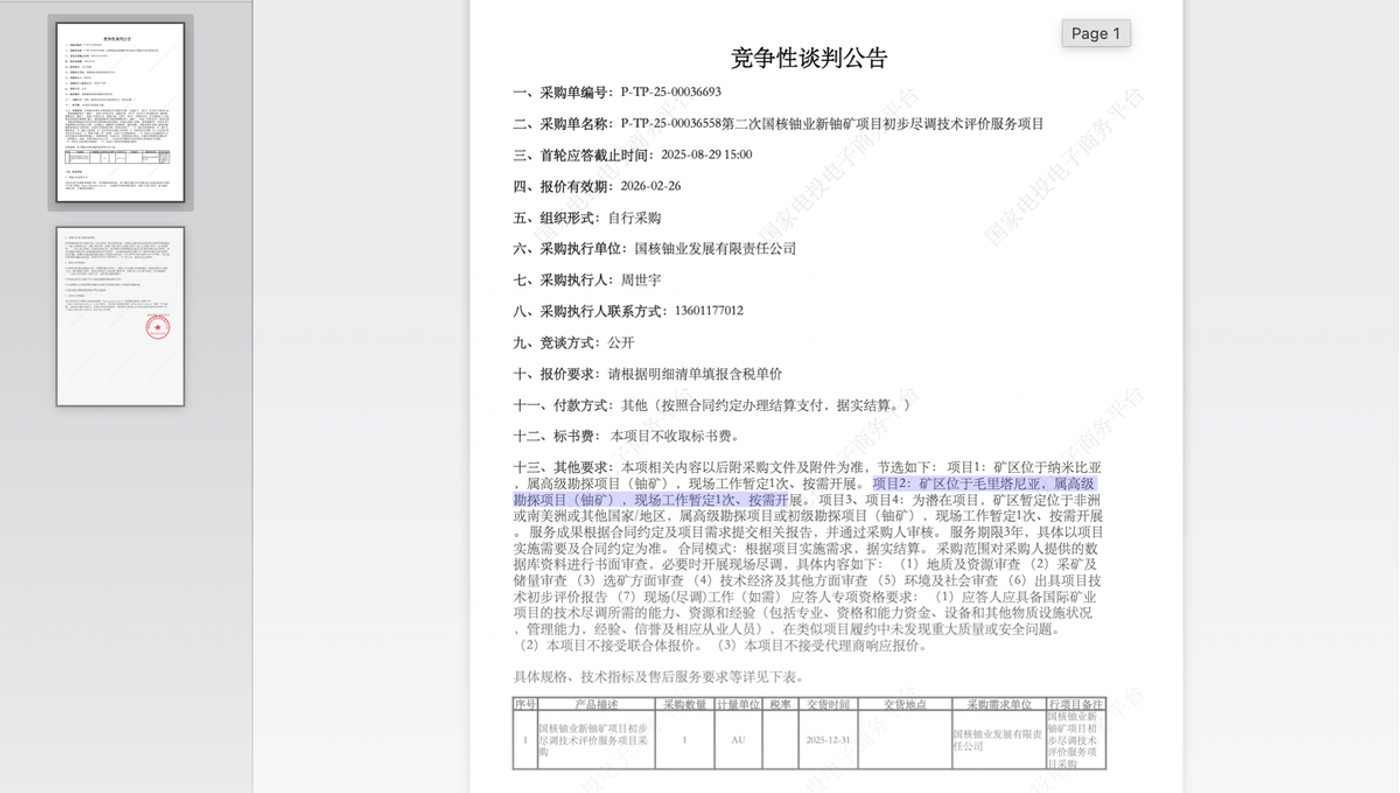
The scope was transactional: the adviser was to review "the seller's valuation model," build SNURDC's internal model, and "assist the purchaser in completing non-binding offer documents."
Bidders had to sit on SPIC's approved valuer panel for 2024–2027 and show experience in cross-border uranium M&A. Awards announcements followed by 5 September 2025: SRK Consulting (China) (北京斯罗柯资源技术有限公司) for technical work, Zhong Lun for legal, EY for financial and tax, Sunshine Law Firm for risk.
Mauritania has never produced uranium. Its only advanced-stage uranium project is Tiris – 85% Aura, 15% the Mauritanian state – with a completed feasibility study, an exploitation licence, and planned output of about 2 Mlb U3O8 a year. "Project 3" can therefore only be Aura Energy’s Tiris. These diligence appointments were programme-wide, so the notices do not say which adviser worked on which project or how far they took them. Screening alone does not establish intent to acquire: SNURDC identified several countries, including Mauritania, Tanzania, and Namibia, but may not have pursued a transaction in any of them.
Aura's Disclosures Run on The Same Calendar
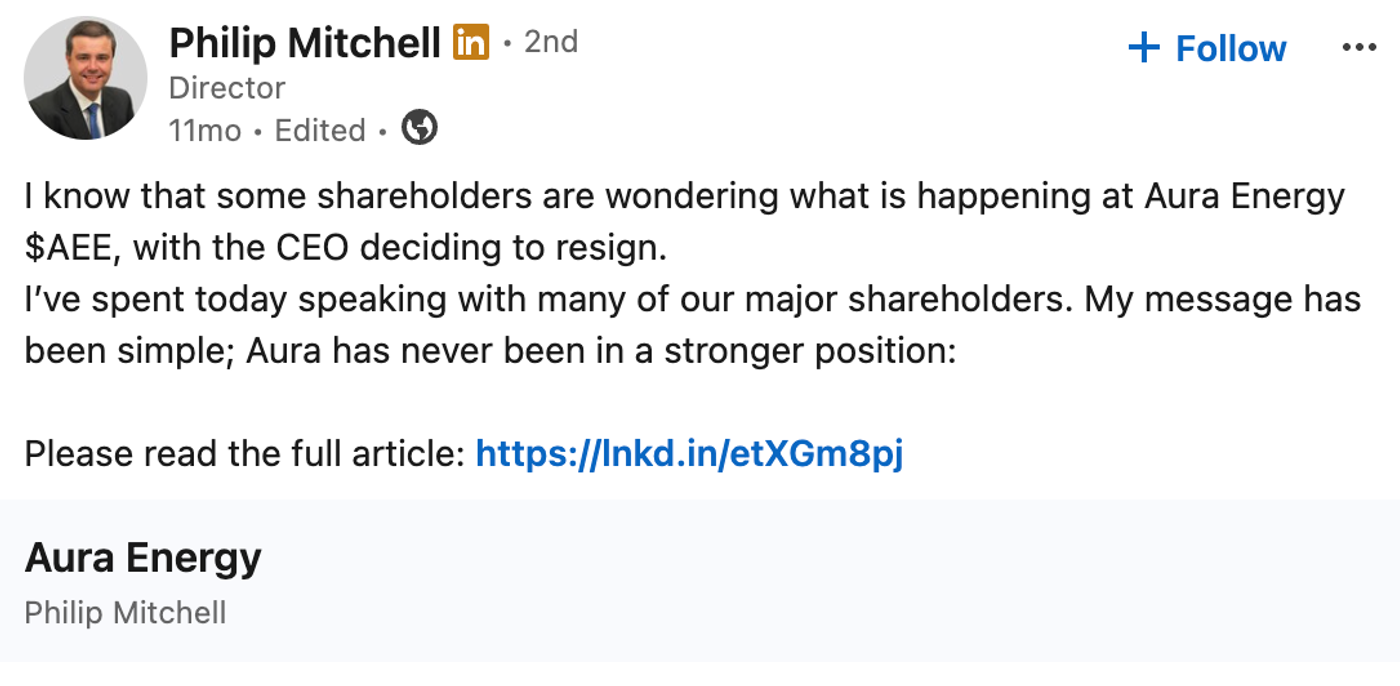
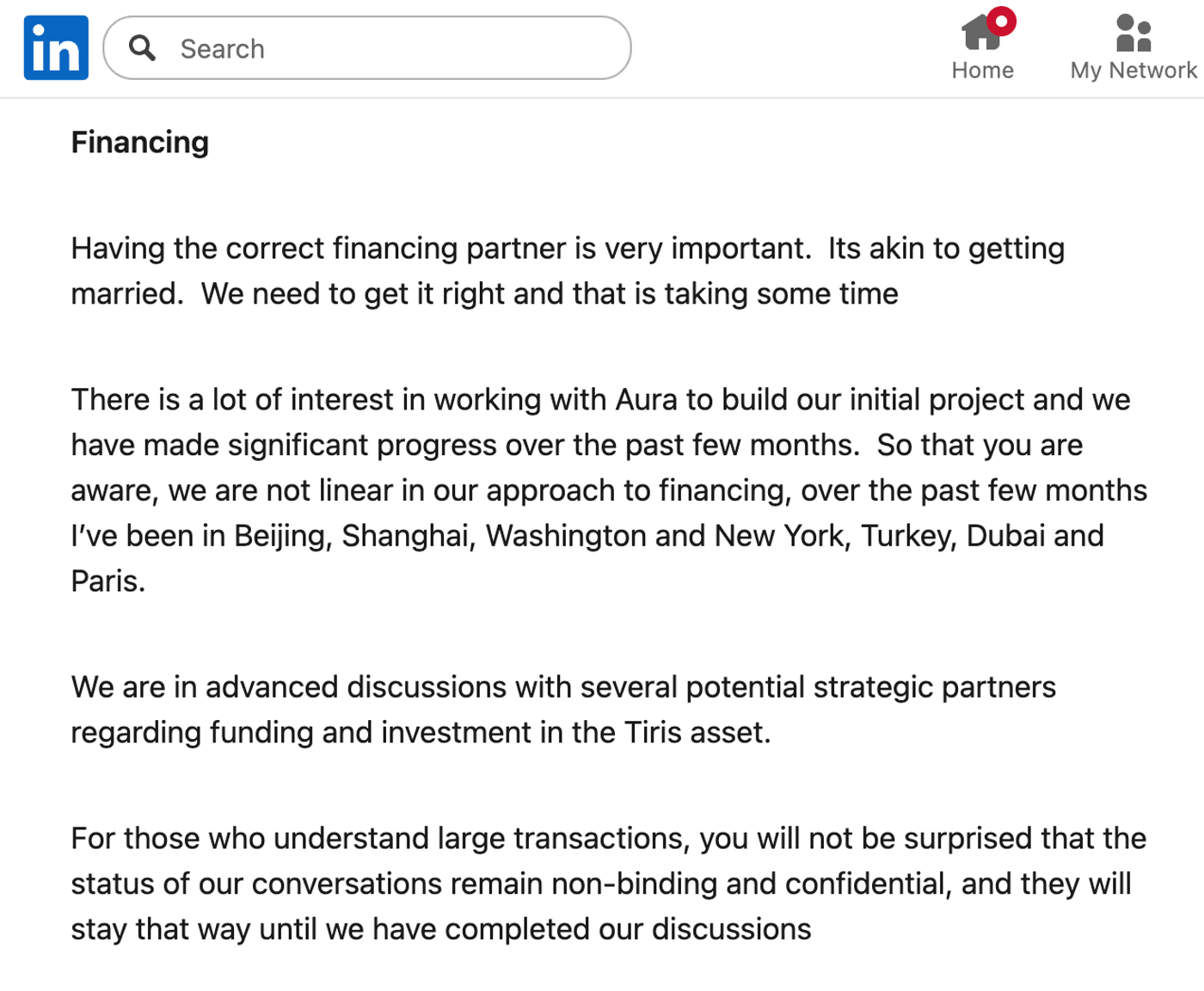
Philip Mitchell became Aura's executive chairman in June 2025 with a mandate to secure financing. On 21 October 2025, he wrote a LinkedIn post on to Aura shareholders addressing the progress of Tiris’ financing. In the post, he stated: "over the past few months I've been in Beijing, Shanghai, Washington and New York, Turkey, Dubai and Paris”. Listing almost every timezone in the world does not help us identify the partner but it does establish the fact he had meetings in China.
The following year, Aura's quarterly report, released in April 2026, disclosed that the company "hosted a site visit in Mauritania with a significant potential Strategic Investor and reciprocated with a senior team visiting the potential investor during which a comprehensive non-binding Memorandum of Understanding was developed." The signing of the MoU was then announced on 2 June.
Mitchell's record raises the prior that Aura would deal with a Chinese counterparty – he worked on Chinalco's investment in Simandou. This, alongside his visits to China last year, only provides circumstantial evidence, but by all accounts, including his own LinkedIn bio, Mitchell appears open to seeking financing from China: “Working closely with China over the past twenty years [...] has been a huge privilege.”
Project Wildebeest: Transaction-Grade Diligence to Aura's Deadline
On 14 May 2026, after Aura disclosed that an MoU was being drafted but before it was signed, SNURDC opened procurement for comprehensive due diligence on a target codenamed 角马, Wildebeest: technical, legal, financial and tax, valuation and risk, plus a financial-adviser mandate.
Awards were published on 11 June: Han Kun (legal), Deloitte (financial and tax), EY (valuation), Sunshine (risk); we have not located the technical award. The financial-adviser procurement was terminated on 11 June, then reopened in July, and awarded to CSC Financial (中信建投证券) on 28 August. The stated delivery date for the legal, valuation, risk and financial-adviser mandates: 31 December 2026, the date which Aura has set to reach a commercial agreement.
Three features of the sequence favour Wildebeest being Tiris. First, a Mauritanian project was screened openly in late 2025; then a target referred to only by codename once Aura entered confidential negotiations. Second, the April 2026 screening round covered "two projects in Northeast Asia and one in Southern Africa." Mauritania had dropped out. Either Tiris was rejected or it had moved beyond screening; the Wildebeest procurement three weeks later is consistent with the second. Third, the Southern African project screened in April cannot easily be Wildebeest itself: its preliminary valuation was due on 30 June 2026, while Wildebeest entered comprehensive diligence on 14 May. Wildebeest therefore most likely came from the 2025 cohort – Namibia, Tanzania or Mauritania – and of those three, only the Mauritanian project has a publicly disclosed strategic-partner process on the same calendar.
The Secondary Signals
“Arabic”
On 30 January 2026, SNURDC tendered a three-year translation services framework naming four languages – English, Russian, Kazakh and Arabic – and requiring bidders with experience in nuclear projects or cross-border mining M&A. Russian and Kazakh serve its stake in JV Zarechnoye, Kazakhstan. Arabic is the more interesting one. The Dubai free-zone vehicle that SNURDC maintains does offer one explanation. A second explanation could be that Mauritania's official language is Arabic. The signal is real but not specific: although the tender mentions “other languages”, it does not explicitly list French, in which much Mauritanian mining and legal documentation is written.
Staffing
On 3 August 2026, SNURDC advertised two permanent roles in an "Africa Project Department" (非洲项目部), which we have not found in earlier SNURDC material: a technical role requiring uranium-mining or hydrometallurgical experience and long-term stationing in Africa, and a business-development role to "advance the establishment of the representative office," support acquisitions, and register local entities. This supports an African transaction. It does not distinguish Mauritania from Namibia or Tanzania.
Physical Trace (1)
We looked for physical evidence of Chinese involvement. In May 2025, South African customs recorded 811 kg of HS code 253090 material ("mineral substances") flown from Mauritania to Johannesburg in the window when Aura's quarterly report placed bulk samples with vendors there; at roughly 225 ppm U3O8, Tiris earth samples could be declared as generic mineral substance rather than uranium ore. Mauritanian exports to China under the same heading (HS 253090) over the following twelve months were small consignments to Guangdong, Zhejiang and Fujian, the ornamental-stone provinces, with one exception: 1,000 kg to a Beijing-registered importer in December 2025 — the only Beijing entry, the largest by mass and value, and the size of a metallurgical bulk sample for testing. SNURDC and its technical consultant for the initial asset screen, SRK China, are in Beijing. China Customs does not publish importer names, so this is as far as the lead can go and all the nuclear majors in China have Beijing offices.
Physical Trace (2)
This one is more of a long shot. In June 2026, customs data showed one industrial centrifuge, HS 84211920, weighing 2,100 kg and valued at RMB 155,412 (about US$22,000), exported from Beijing to Mauritania under customs regime 22, “goods for overseas contracted projects” (i.e., for Chinese contracted projects). That same month Aura declared a settled flowsheet built around pre-leach centrifuge separation, with the partner’s “technical arm” assisting with the pilot plant.
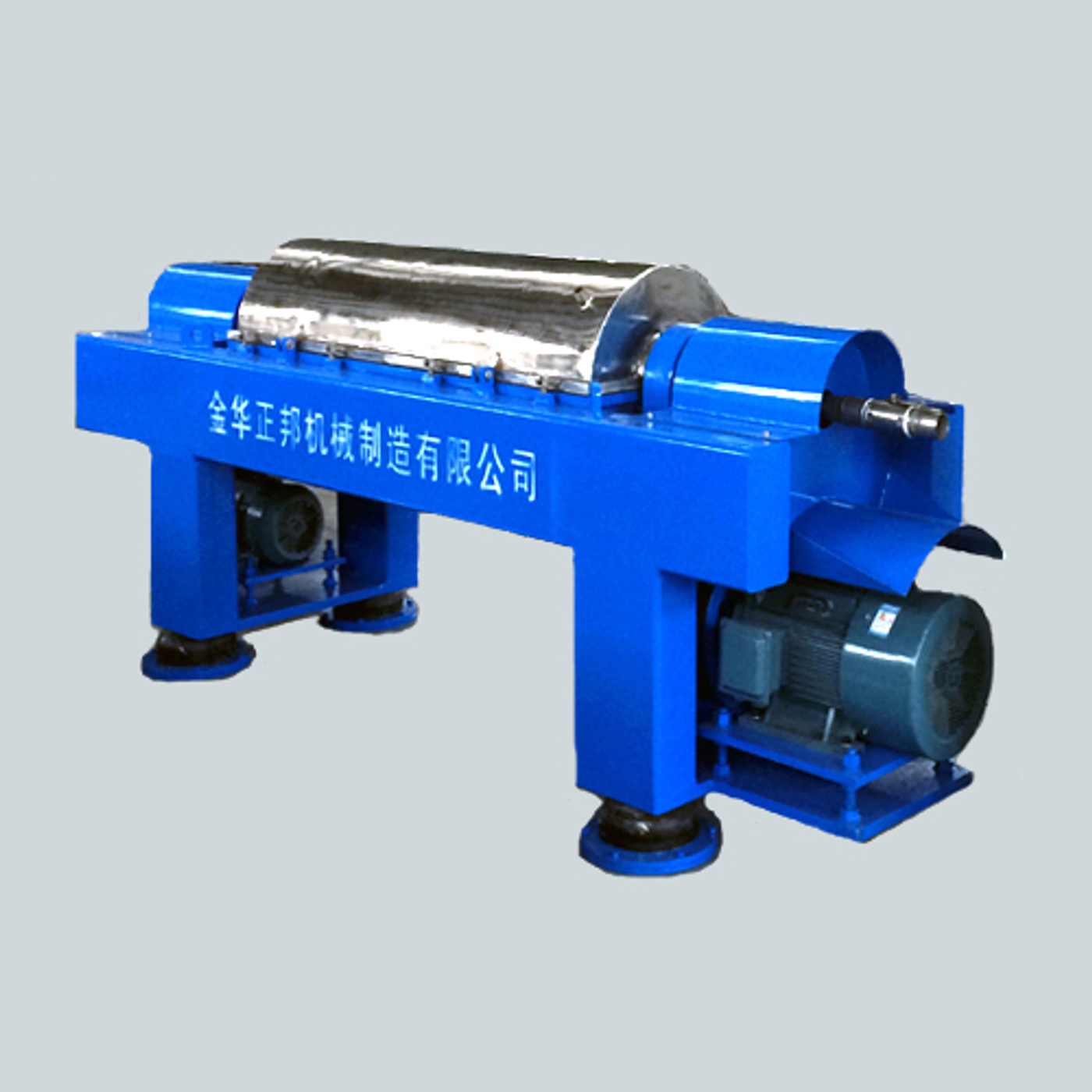
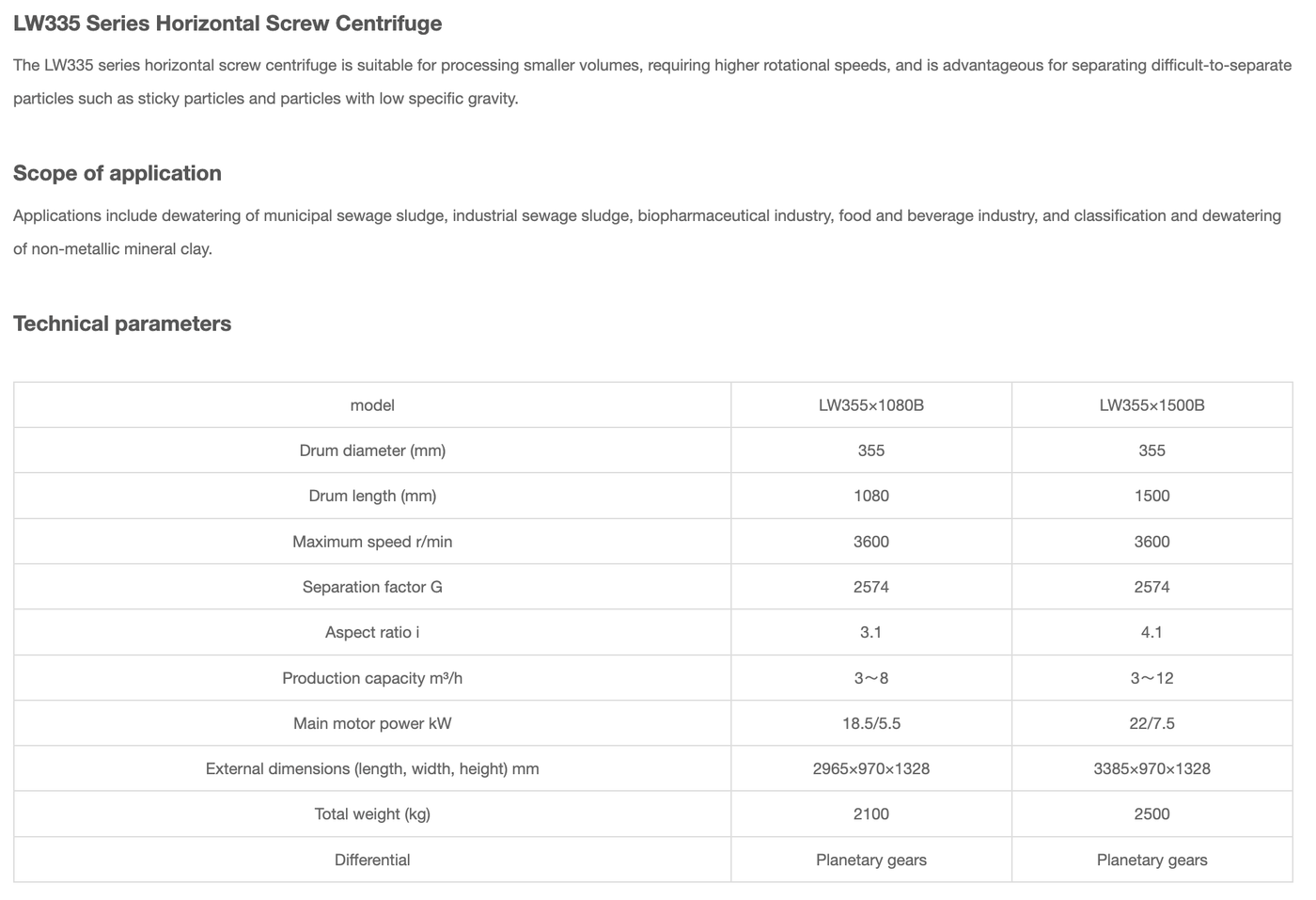
Figures 5 and 6 show a Chinese LW355×1080B horizontal decanter centrifuge with a catalogue weight of exactly 2,100 kg and a stated capacity of 3–8 m³/h. Its listed applications include clay separation and sludge dewatering. That makes it a plausible candidate for pilot testwork, although the weight and price do not establish either the model or its destination.
The main alternative recipient we found was China Machinery Engineering Corporation’s (CMEC) wastewater project in Mauritania’s capital, Nouakchott. We could not find a public centrifuge tender tied to CMEC’s project, but an older detailed design explicitly specifies centrifuge dewatering. Its sludge forecasts suggest the full plant would need substantially more capacity than the one we identified, weighing 2.1 tonnes, whether through larger machines or several units; we have not verified CMEC’s final equipment specification. CMEC therefore remains a credible alternative. The match is circumstantial and does not identify SNURDC, but the timing alongside Aura’s pilot work is interesting.
Capital
On 19 August 2026, SNURDC tendered a special-purpose asset valuation and special audit "for equity financing" (权益融资), the standard preparatory steps for a state enterprise raising equity. The use of proceeds is not stated but it comes at the same time as advanced diligence on Wildebeest.
Arguments Against SNURDC
The Codename
Wildebeest range across eastern and southern Africa, not the Sahara. If SNURDC names deals zoologically, the name points to Tanzania or Namibia. Its one other historical codename does not tell us much: "Project Uranus", for the acquisition of Uranium One’s stake in a Kazakh joint venture.
The Alternatives
We screened alternative uranium projects in Africa. Three are plausible but we do not think any of them are Wildebeest.
- Norasa (Namibia): Asarian (formerly Forsys) said in November 2025 that it was exploring offtake or a strategic partner, and repeated it in July 2026 — but in the same filing, capital works are on hold pending financing, further studies are needed to attract a partner, and its environmental clearance lapsed in May. Norasa seems early for Wildebeest’s level of diligence.
- Tumas (Namibia): The right scale and timetable, with an investment decision due in the fourth quarter of 2026. But Deep Yellow held A$160 million as of June, has Nedbank Namibia mandated to arrange debt, lists "strategic funding" as one option among several, and has disclosed no counterparty. Nothing in its disclosures points to a transaction.
- Mkuju River (Tanzania). Rosatom is developing the project via its subsidiary Uranium One, which sold SNURDC its Zarechnoye stake in 2024. In May 2026, Rosatom was still negotiating debt with Russian and Tanzanian banks, with lenders deterred by a licence that expires in April 2028; the codename fits Tanzania. But no Chinese footprint appears in the Tanzanian record here.
None of these can be excluded, but none show public evidence of a transaction on the Wildebeest calendar.
The American Track
Aura's June announcements still describe "advanced discussions" with the US International Development Finance Corporation for US$150-170 million of senior debt, and a non-binding proposal from a US investment fund. The DFC exists in part to offer an alternative to Chinese state finance; we judge it highly improbable that DFC senior debt and a Chinese state equity partner would coexist in one capital structure. Aura presents the tracks as alternatives, and the MoU covers "alternative financing arrangements." This is the strongest evidence against our judgment and the easiest to test: if the DFC track advances to a term sheet alongside the utility deal, we are wrong. The August 2025 offtake with a US utility, for roughly 10% of output in 2028-2031, is a sales contract and not inconsistent with a Chinese equity partner.
The Approvals Horizon
Aura's 30 June 2027 target for "board and regulatory approvals," six months after the commercial agreement, is consistent with the Chinese approval cycle: Bannerman's CNNC deal, signed in February 2026 subject to NDRC and MOFCOM filings, foreign-exchange registration and Namibian competition clearance, had its conditions satisfied in September 2026, seven months later. It is, however, also consistent with any regulated investor.
Why SNURDC Would Invest
CNNC holds Rössing and a quarter of Langer Heinrich and is completing Etango; CGN holds Husab, Africa’s largest uranium mine. SPIC has a growing CAP1000 fleet and, as far as the public record shows, one producing overseas uranium asset: 49.979% of Zarechnoye JV in Kazakhstan, bought from Uranium One in 2024. In August 2026, Kazatomprom’s CFO, speaking on Zarechnoye, said: “production will decline by 2028, and after that this mining asset will be closed”. CNNC also hold exclusive rights to domestic uranium mining. In short, SNURDC needs a new mine.
SNURDC's African screening began in 2025. Tiris is a shallow calcrete deposit, now with a settled flowsheet, a bankable study due this month and, on Aura's earlier disclosures, an eighteen-month build. For a buyer whose only mine will shortly be depleted, that timetable is very attractive.
What it Means
If we are right, the significance goes beyond Aura appearing on track to reach a Final Investment Decision after years of target dates slipping. It would mean that by mid-2027 all major Chinese nuclear operators would hold equity in African uranium. The Etango structure — a project-level stake, majority offtake to the partner, pro-rata funding — is the established template for how the deal would be structured. Most significantly, a project with a DFC funding track and US utility offtake would have gone to a Chinese buyer while the DFC was finishing its due diligence. For Aura shareholders, the next milestones are the September BFS, Q3 pilot plant results and, if all goes to plan, a commercial agreement by 31 December, when the partner is likely to be named.